

.jpg?width=615&height=346&name=Article%20Images%20(3).jpg)
Selecting a facilities management partner is no longer about securing the lowest hourly rate. In 2026, leading organizations evaluate providers based on who can deliver the lowest total cost of ownership (TCO) across the full lifecycle of their assets.
This guide outlines how to evaluate FM providers through a lifecycle cost lens, structure KPI-driven pilots, and contract for measurable outcomes that deliver durable return on investment (ROI).
For additional context on why lifecycle decisions have become the battleground for facilities spend, see Vixxo’s perspective on containing facility and equipment costs and total cost of ownership (TCO): https://www.vixxo.com/resources/containing-facility-and-equipment-costs
Understanding Lifecycle Costs in Facility Management
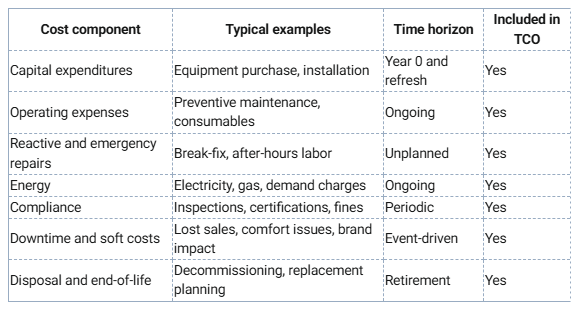
Lifecycle costs represent the total expense of an asset from acquisition through operation, maintenance, and retirement. In facilities, TCO extends well beyond purchase price or labor rates to include energy consumption, repairs, compliance, downtime, and end-of-life replacement.
Focusing only on upfront costs often leads to higher long-term spend. Short-term savings achieved through deferred maintenance, low-bid repairs, or fragmented vendors frequently result in more emergency work, premature asset failure, and lost revenue.
Integrated FM models that manage assets holistically typically reduce lifecycle costs by 15% to 25% compared to siloed, transactional approaches. Savings come from fewer emergency dispatches, better first-time fix rates, extended asset life, and improved energy performance.
TCO vs. Common Facility Cost Components
Defining Key Lifecycle Performance Indicators
Reducing lifecycle costs starts with managing the right key performance indicators (KPIs). Facilities leaders should prioritize metrics that link asset performance to business outcomes.
Key lifecycle KPIs include:
- Mean time between failures (MTBF): Measures asset reliability and predicts reactive spend.
- Asset uptime: Percentage of time equipment is operational and supporting revenue or safety.
- Energy consumption per square foot: Normalizes energy performance across sites.
- Reactive maintenance ratio: Percentage of work that is unplanned versus preventive or predictive.
-
Occupant or tenant satisfaction: Indicator of comfort, service quality, and operational effectiveness.
Selecting a focused set of KPIs aligned to the business is critical. Retail and restaurant operators prioritize uptime and speed of repair. Grocery and foodservice environments emphasize refrigeration reliability and energy intensity. Regulated environments require compliance consistency.
Establishing a Portfolio Baseline
Before evaluating providers, organizations should establish a clear baseline of asset condition and cost performance.
A rapid baseline typically includes 12 to 24 months of data across:
- Asset inventory with age, criticality, and warranty status
- Preventive versus reactive maintenance spend
- Failure frequency and average repair duration
- Energy usage and peak demand by site
- Compliance history and open deficiencies
- Data quality gaps such as missing serial numbers or duplicate records
Digital assessments and mobile audits accelerate this process and ensure consistency across large portfolios.
Evaluating Facility Management Providers for Lifecycle Value
Providers that deliver low lifecycle costs look fundamentally different from price-first vendors.
Facilities leaders should evaluate FM partners based on:
- An integrated facilities management platform that unifies work orders, asset data, spend, and warranties
- Predictive maintenance and analytics capabilities that reduce failures before they occur
- Centralized dispatch and triage to minimize truck rolls and emergency labor
- Mobile-first field tools that improve repair quality and documentation
- Transparent reporting tied to lifecycle KPIs
- Data ownership, interoperability, and export access
Live demonstrations and short pilot programs are essential. Providers should be willing to prove lifecycle impact using real asset data, not just feature lists.
Running KPI-Driven Pilot Programs
Pilots reduce risk and quantify lifecycle value before full rollout.
A best-practice pilot includes:
- A defined scope of 3 to 10 representative sites and priority asset classes
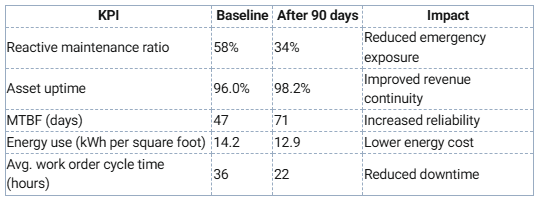
- Clear baseline metrics for uptime, MTBF, reactive ratio, energy intensity, and work order cycle time
- Weekly operational dashboards and 30, 60, and 90-day reviews
- Incentives tied to outcomes, not activity volume
- A documented go or no-go decision and scale plan
Example Pilot Outcomes
Contracting for Outcome-Based Facility Management
Outcome-based contracts align provider incentives with lifecycle performance.
Strong agreements include:
- Service-level agreements tied to uptime, energy reduction, compliance, and response time
- Shared savings models based on validated baselines
- Full data transparency and audit rights
- Quarterly lifecycle optimization reviews and continuous improvement plans
When compensation is linked to results, providers focus on preventing failures and extending asset life rather than maximizing labor hours.
Using Technology to Reduce Lifecycle Costs
Technology is now a primary lever for TCO reduction.
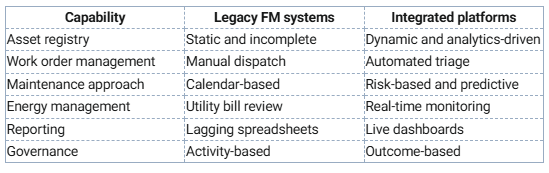
IoT-enabled monitoring supports predictive maintenance by identifying anomalies before failure. Integrated platforms centralize asset intelligence and automate triage. Energy management systems optimize schedules and reduce peak demand.
Legacy FM Systems vs. Integrated Platforms
In 2026, the facility management partners that deliver the most value will be those that manage assets across their full lifecycle, not just the moment a work order is opened.
Frequently Asked Questions
How do lifecycle costs impact total facility management spend?
Lifecycle costs capture all expenses across an asset’s life, often dwarfing initial purchase or labor rates.
What technologies reduce equipment lifecycle costs?
Predictive maintenance, integrated platforms, and energy analytics reduce failures and unnecessary spend.
What are outcome-based FM contracts?
They tie provider compensation to measurable results such as uptime, energy savings, and compliance.
Which metrics matter most for managing TCO?
Asset uptime, MTBF, energy intensity, reactive maintenance ratio, and satisfaction scores.
Why does integrated FM outperform transactional models?
Integrated partners reduce handoffs, improve accountability, and manage assets for long-term value rather than short-term fixes.
Want to talk facilities?
Leave a comment or question below and we'll reach out!