

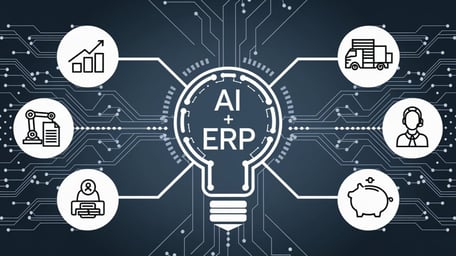
Enterprise leaders are moving quickly toward AI-driven Enterprise Resource Planning (ERP) platforms to modernize finance, supply chain, and operations. Yet many of these transformations stall when it comes to facilities, one of the largest and most complex operating expenses in multi-site organizations.
This is where facilities outsourcing becomes critical. Without an execution model that can operationalize AI-driven insights at scale, ERP platforms expose problems they are not designed to solve.
Why Facilities Are a Blind Spot in ERP and AI Programs
ERP transformations typically prioritize functions with clean data structures and centralized ownership. Facilities management is different. It is decentralized, trade-specific, and operationally complex.
From a consultant’s perspective, facilities often present red flags:
- Thousands of reactive work orders with inconsistent data
- Fragmented service provider networks
- Limited insight into true Total Cost of Ownership (TCO)
- Internal teams stretched thin and focused on firefighting
Even the most advanced AI-driven ERP platform cannot correct these structural issues on its own. Without an execution model behind the data, facilities remain an analytical gap in an otherwise modernized enterprise.
The Real Cost of Doing Nothing
For facilities leaders and consultants alike, inaction carries measurable risk. According to the NACS State of the Industry Report 2025, facility expenses increased 4.9% in 2023 and surged another 11.8% in 2024, outpacing overall Direct Store Operating Expense (DSOE).
When organizations delay change in facilities management, costs escalate in predictable ways:
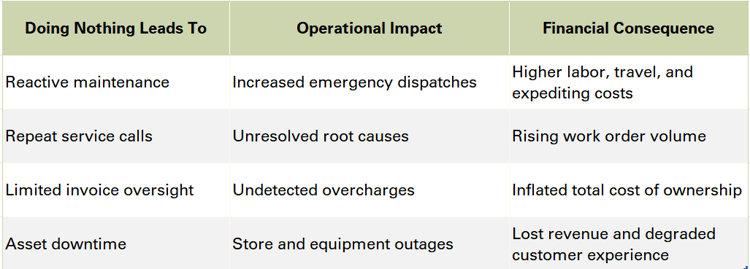
Doing nothing is not a neutral choice. It compounds inefficiencies while masking root causes behind growing spend.
Why Technology Alone Falls Short
Many ERP programs assume that connecting facilities data to a Computerized Maintenance Management System (CMMS) or AI-driven platform will create control. In reality, technology delivers visibility, not execution. Without a model to act on insights at scale, facilities issues remain visible but unresolved, which is where outsourcing becomes critical.
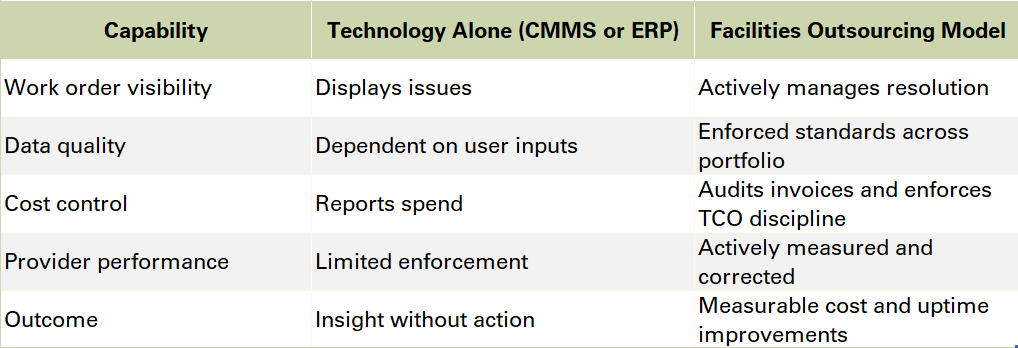
Facilities management requires daily intervention. Without people, process, and accountability layered onto technology, ERP investments fail to deliver measurable facilities savings.
Outsourcing as an Execution Layer for ERP Success
Outsourcing facilities management is increasingly viewed by consultants as an execution strategy, not a cost-cutting shortcut.
At Vixxo, facilities operations are supported by technology like VixxoLink, which connects assets, service providers, and facilities experts in one platform. AI enhances diagnostics, invoice validation, and response times, while human expertise ensures corrective actions are enforced across the portfolio.
For ERP initiatives, this model improves both cost outcomes and data integrity.
Why Consultants Are Increasingly Recommending Outsourcing
From a consulting lens, outsourcing facilities management helps de-risk transformation programs:
- Reduces operational noise that distracts leadership
- Converts facilities from a reactive cost center into a managed spend category
- Improves the quality of data feeding ERP and financial systems
- Accelerates time to value without adding internal headcount
Instead of asking internal teams to absorb new responsibilities during an ERP rollout, outsourcing creates capacity while driving measurable results.
Acting Now Versus Paying Later
Facilities decisions made today shape enterprise performance for years. Deferred maintenance, unmanaged providers, and poor data quality become harder to unwind over time.
Organizations that act early see compounding benefits:
- Lower total cost of ownership
- Fewer emergency repairs
- Clearer insights for capital planning and reinvestment
For both consultants and facilities leaders, the message is the same. The cost of doing nothing is rarely visible in a single budget cycle, but it is always felt in the long run.
Facilities Management as a Strategic Lever
AI-driven ERP decisions matter now, but they are incomplete without a facilities execution strategy. Outsourcing bridges the gap between insight and impact, enabling organizations to realize the full value of their transformation investments.
Facilities may not be the loudest line item, but they are one of the most controllable. Treating them strategically is no longer optional.
FAQs
Why should consultants care about facilities outsourcing?
Facilities costs are a major contributor to operating expense. Poor execution undermines ERP ROI, while effective outsourcing improves outcomes and reduces transformation risk.
Can outsourcing coexist with AI-driven ERP platforms?
Yes. Outsourcing strengthens ERP programs by improving data quality, enforcing standards, and turning insights into action.
When should facilities outsourcing be introduced?
Ideally alongside or shortly before ERP initiatives, when organizations are already focused on modernization and cost discipline.
Want to talk facilities?
Leave a comment or question below and we'll reach out!