

As remodels, refreshes, and technology rollouts accelerate in 2025, retail and restaurant operators are asking a practical question: where can I find project managers who can execute consistently across dozens or thousands of locations? This project manager buyer's guide is designed for facilities and operations leaders who need national reach, standardized delivery, and predictable outcomes across multi-site programs.
Today’s multi-location projects are more complex than ever. Labor constraints, rising costs, regulatory requirements, and new technology integrations leave little room for fragmented execution. The right national project manager provides centralized oversight, disciplined governance, and real-time visibility from planning through closeout.
Why National Project Management Matters in 2025
Multi-site programs now operate under tighter timelines and greater executive scrutiny. Facilities leaders are expected to deliver projects on time, within budget, and without disrupting daily operations. National project managers help meet those expectations by coordinating scope, schedule, vendors, and reporting through a single program structure.
Centralized project management reduces inconsistencies across regions, shortens decision cycles, and creates a clear escalation path when issues arise. For distributed retail and restaurant portfolios, this approach improves uptime, limits rework, and protects brand standards.
National Project Manager Categories for Multi-Site Retail and Restaurant Projects
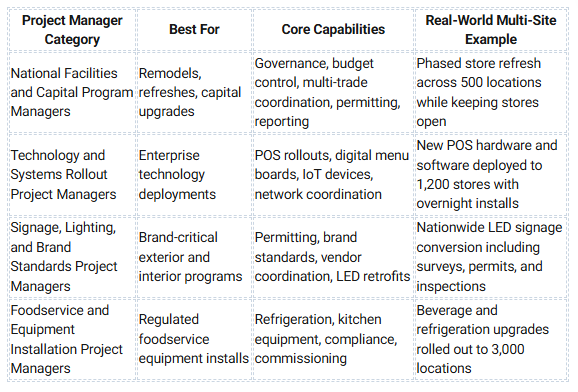
This buyer's guide organizes national project managers by category, the types of projects they support, their core execution capabilities, and real-world multi-site examples. Use the table below to quickly identify the project management model best aligned to your portfolio scope, complexity, and rollout goals.
What to Look for When Evaluating a National Project Manager
Regardless of category, strong national project managers share several traits. They demonstrate proven multi-region delivery, enforce standardized playbooks, and provide portfolio-level reporting rather than site-by-site updates. Facilities leaders should also prioritize experience with fixed-scope execution, change control discipline, and cross-functional coordination between facilities, IT, operations, and vendors.
Equally important is the ability to mobilize quickly. The best project managers maintain established labor relationships, understand jurisdictional permitting differences, and can scale resources up or down without sacrificing quality.
Planning, Resource Optimization, and Governance at Scale
Successful multi-site execution depends on aligning labor, materials, and schedules across regions. National project managers protect timelines by confirming scope early, modeling regional capacity, sequencing rollout waves, and dynamically reallocating resources when disruptions occur.
Governance plays a critical role as well. Defined decision gates, documented approvals, audit trails for scope changes, and standardized closeout processes reduce risk and improve accountability. Photo verification, punch lists, and acceptance sign-offs help ensure every location meets the same standards before handoff.
Measuring Success Across Multi-Site Projects
Key Performance Indicators, or KPIs, provide objective insight into program performance. Common metrics include on-time site completion, budget variance, time to operational readiness, utilization rates, repeat work, and stakeholder satisfaction. When tracked consistently across locations, these metrics allow facilities leaders to identify trends, address risks early, and continuously improve execution.
How to Use This Buyer's Guide
Start by identifying the category that aligns with your primary initiative, whether that is a remodel, technology rollout, signage refresh, or equipment installation program. Review case studies that demonstrate true national execution, not isolated regional work. Validate governance processes, reporting transparency, and change management capabilities before launching a pilot scope.
Frequently Asked Questions
What makes a project manager “national” for retail and restaurant projects?
A national project manager can mobilize across regions, standardize execution, manage vendors centrally, and report performance at the portfolio level.
Why is centralized project management important for multi-site programs?
Centralization reduces variability, improves visibility, and delivers more predictable timelines and costs across all locations.
What type of project manager should I choose for my initiative?
The right choice depends on your scope. Remodels, technology rollouts, signage programs, and foodservice installations each require different expertise.
Want to talk facilities?
Leave a comment or question below and we'll reach out!