
For multi-site retail, restaurant, grocery, and convenience operators, Total Cost of Ownership (TCO) has moved from a finance discussion to a facilities imperative. Rising labor rates, aging equipment, energy volatility, and tighter operating budgets are forcing facilities leaders to reexamine how maintenance decisions are made and measured.
The core challenge is this: many organizations still optimize for visible costs, such as hourly labor rates or trip charges, while the true cost of maintenance is driven by outcomes over time. Facilities programs that fail to account for repeat calls, downtime, asset lifespan, and energy inefficiency consistently overspend and underperform.
What Total Cost of Ownership Really Means in Facilities Management
Total Cost of Ownership reflects the full lifecycle cost of maintaining facilities and equipment, not just the invoice attached to a single service call.
Key components of facilities TCO include:
- Labor, travel, and parts costs
- Repeat repairs and callbacks
- Downtime and lost sales
- Energy consumption and inefficiency
- Asset lifespan and replacement timing
- Internal labor and administrative overhead
Facilities leaders who rely on rate-based decision-making often underestimate how quickly these hidden costs compound across hundreds or thousands of locations.
The Hidden Cost Drivers Undermining Facility Budgets
TCO inflation rarely comes from one large failure. It builds quietly through operational friction.
Common challenges that increase TCO:
- Short-term fixes that fail to address root causes
- Inconsistent repair quality across regions and providers
- Poor visibility into time on site versus labor billed
- Preventive maintenance programs that are skipped or inconsistently executed
- Aging equipment managed reactively instead of strategically
Industry research and facilities assessments consistently show that repeat and duplicate work orders can represent 20% or more of reactive maintenance volume in distributed portfolios when left unmanaged.
Rate Focus vs. TCO Focus: Why Hourly Rates Mislead
Facilities teams are often pressured to negotiate the lowest possible labor rates. The data tells a different story.
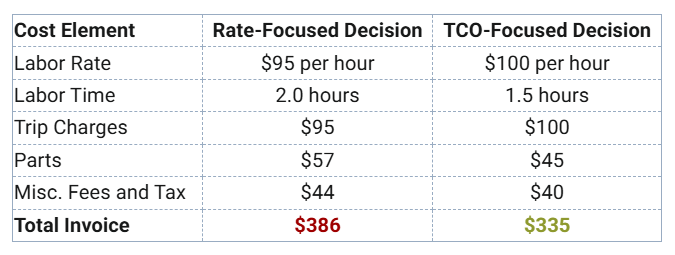
Although the TCO-focused approach uses a higher hourly rate, the total invoice is 13% lower due to faster resolution, fewer parts, and reduced likelihood of repeat service.
Mini Case Study: Shifting to a TCO-First Maintenance Strategy
A large North American retailer with a highly distributed portfolio reviewed its facilities program after multiple years of rising maintenance spend, despite renegotiated service rates.
Before the Shift
- Reactive maintenance dominated spend
- High callback and repeat repair rates
- Limited invoice transparency
- Growing emergency service volume
After the Shift
- Preventive maintenance prioritized by asset criticality
- Root-cause repair standards enforced
- Invoice validation expanded beyond labor rates
- Performance measured by outcomes, not speed alone
Results
- Millions in identified cost reduction opportunities
- Fewer emergency dispatches
- Measurable improvement in store quality and asset uptime
- Stabilized year-over-year maintenance spend
The biggest gain was not a single cost cut, but a reduction in repair volume and avoidable work over time.
Strategic Shifts Facilities Leaders Are Making in 2025
Facilities leaders who are successfully reducing TCO are changing how they manage programs, providers, and performance.
Key strategic shifts include:
- Moving from reactive to preventive and predictive maintenance
- Measuring providers by first-time fix rate and repeat calls
- Using asset data to guide repair versus replace decisions
- Centralizing accountability and performance oversight
- Treating facilities as revenue-protecting assets, not overhead
Studies consistently show that planned maintenance costs significantly less than unplanned maintenance and can reduce emergency repair volume by 35–40% over several years when executed consistently.
How to Start Reducing Total Cost of Ownership
Facilities teams do not need to overhaul everything at once to make progress on TCO.
Practical first steps include:
- Auditing invoices for repeat calls and excessive labor durations
- Identifying high-cost outlier locations and trades
- Aligning preventive maintenance frequency with asset criticality
- Tracking total cost per asset instead of cost per visit
- Partnering with a facilities management provider built around outcomes, not transactions
Organizations that take a disciplined, data-driven approach to TCO consistently outperform those focused only on short-term cost controls.
Frequently Asked Questions About TCO in Facilities Management
What is Total Cost of Ownership in facilities management?
Total Cost of Ownership includes all direct and indirect costs associated with maintaining facilities and equipment over their full lifecycle, including repairs, downtime, energy use, and replacement costs.
Why do low labor rates often increase overall maintenance costs?
Lower labor rates often lead to longer repair times, lower-quality fixes, repeat visits, and more downtime, all of which increase total cost over time.
How long does it take to see results from a TCO-focused strategy?
Most organizations begin seeing cost stabilization within 6–12 months, with longer-term reductions in repair volume and emergency spend following thereafter.
Is preventive maintenance always more cost-effective than reactive maintenance?
Yes. Unplanned reactive maintenance can cost 3–9 times more than planned maintenance once emergency fees, downtime, and repeat repairs are considered.
Want to talk facilities?
Leave a comment or question below and we'll reach out!