

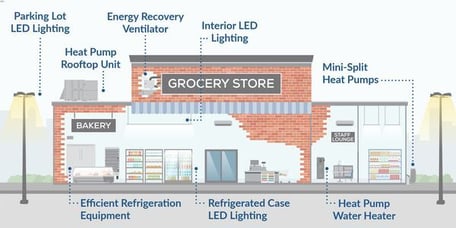
Header image source: Efficiency Maine, Grocery and Convenience Store Energy Use, efficiencymaine.com
For convenience stores and grocery retailers, HVAC/R performance directly affects food safety, customer experience, energy spend, and store uptime. These environments operate long hours, rely heavily on refrigeration, and face strict compliance requirements. The wrong service partner can turn small failures into costly emergencies and product loss.
Selecting the right HVAC/R provider requires evaluating more than hourly rates. Facilities leaders must assess refrigeration depth, energy optimization capabilities, service scalability, and the ability to deliver consistent outcomes across a multi-site portfolio.
Understand High-Load Retail HVAC/R Requirements
Both convenience stores and grocery stores operate under continuous, high-load conditions. Dense refrigeration, frequent door openings, lighting heat, and extended operating hours place constant stress on HVAC/R systems.
Industry guidance shows food retail formats consume significantly more energy per square foot than typical commercial buildings due to refrigeration intensity and continuous operation, making efficiency and uptime essential for profitability and compliance (source: AAON food retail guidance).
HVAC/R refers to heating, ventilation, air conditioning, and refrigeration systems that regulate indoor comfort and preserve perishable inventory. In food retail, even short outages can trigger food safety risk, lost sales, or regulatory exposure.
Prioritize Refrigeration Expertise and Monitoring
Refrigeration is the most critical asset category for both grocery and convenience retail. A qualified HVAC/R provider must demonstrate experience with walk-ins, cases, rack systems, and distributed refrigeration layouts.
Leading programs include continuous temperature monitoring, alarm management, and remote diagnostics. A refrigeration monitoring system uses sensors and controls to track temperatures and system health in real time, alerting teams before issues escalate.
Advanced alarm management services, such as Copeland-style ProAct programs, triage alerts, prioritize response, and document corrective actions across large portfolios. These capabilities reduce food loss, minimize emergency dispatches, and support audit readiness.
Evaluate Energy Optimization and Controls Integration
Energy is often one of the largest controllable operating expenses in food retail. Providers should support controls integration, Building Management System (BMS) connectivity, and energy optimization tools that adjust HVAC and refrigeration operation based on real-world conditions.
Energy optimization tools use automation or AI to align system performance with weather, occupancy, and load. Retail deployments show measurable reductions in energy use and peak demand when systems automatically tune during low-traffic periods (source: BrainBox AI retail examples).
Facilities teams should look for portfolio-level visibility, exception alerts, and reporting that ties energy performance to operational outcomes.
Assess Serviceability for Active Retail Environments
Grocery stores and convenience stores have limited tolerance for downtime and disruption. Equipment design and service models must account for tight mechanical spaces, live selling environments, and food safety protocols.
Priority considerations include compact equipment footprints, modular components, accessible service panels, and standardized parts. Quiet operation and fast service access reduce customer disruption and speed time to repair, especially during store hours.
Confirm Reliability and Digital Diagnostics
Reliability technology is essential for preventing emergency repairs. Digital diagnostics are embedded system features that continuously monitor performance, detect early faults, and deliver actionable alerts.
Key reliability features include variable speed drives, embedded sensors, trend logging, and fault detection. Ultra-low harmonic drives help stabilize power quality and reduce electrical stress on refrigeration systems, improving equipment lifespan and return on investment (source: ABB commercial refrigeration guidance).
Providers should explain how diagnostic data is actively used to reduce failures, not just collected.
Verify Credentials, Licensing, and Compliance
Facilities leaders should verify that HVAC/R partners maintain proper licensing, insurance, and technician certifications across all operating regions.
ACCA (Air Conditioning Contractors of America) and NATE (North American Technician Excellence) credentials signal adherence to industry best practices, training, and safety, key indicators for complex HVAC/R scopes. Technicians handling refrigerants must also hold EPA Section 608 certifications.
Retail and grocery references, especially from multi-site portfolios, provide insight into real-world performance.
Visualize Geographic Risk Instead of Comparing Rates
HVAC/R costs vary by market, but regional rate comparisons rarely capture true operational risk. Labor availability, response times, travel distance, and repeat failures often drive cost more than hourly rates.
Facilities teams increasingly rely on portfolio heat maps or market dashboards to visualize where HVAC/R spend, emergency calls, or downtime cluster. These views help identify outlier locations that drive disproportionate cost and risk across the network.
Rather than focusing on regional pricing alone, evaluate whether a provider can normalize service standards, surface market-level insights, and apply consistent governance across geographies.
Compare Service Plans for Multi-Site Food Retail
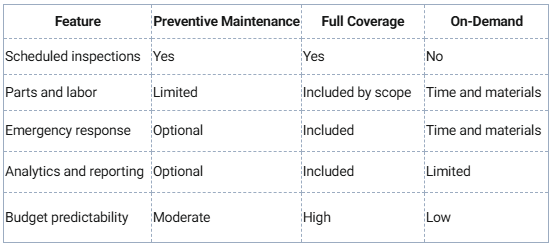
Service plan selection determines predictability and uptime across your portfolio. A preventive maintenance plan is a contract for routine, scheduled inspections and servicing that reduces breakdowns and reactive spend. Common plan types:
- Preventive maintenance (PM): Scheduled inspections, cleaning, calibration, and basic parts — best baseline for uptime and cost control.
- Full coverage: PM plus most parts/labor for repairs — higher predictability, higher premium.
- On-demand (T&M): Pay-as-you-go repairs — flexible but often costlier and riskier for c-stores.
For multi-site retailers, must-have features include:
- Centralized contract management and standardized scopes
- Consistent SLAs by criticality and market
- Asset performance analytics and lifecycle planning
- 24/7 emergency dispatch with clear escalation
- Portfolio dashboards for spend, work orders, and first-time fix rate
For a deeper dive on scale-ready features, see Vixxo’s guide to multi-site HVAC service plans.
Plan feature comparison example:
Negotiate SLAs Built for Food Retail
Service level agreements define response times, escalation paths, and performance expectations. For grocery and convenience stores, SLAs should include 24/7 emergency response, priority tiers tied to food safety risk, preventive maintenance schedules, and invoice transparency.
Quarterly performance reviews and KPI reporting help ensure service quality and cost control over time.
Frequently Asked Questions
What credentials should HVAC/R providers have for grocery and convenience stores?
Look for valid licensing, insurance, EPA Section 608 certification, and credentials such as ACCA or NATE.
Why is refrigeration monitoring critical in food retail?
Continuous monitoring prevents spoilage, supports food safety compliance, and reduces emergency repairs.
How should facilities teams evaluate HVAC/R partners across multiple regions?
Use itemized site assessments and portfolio-level performance data rather than regional rate comparisons.
What service plan works best for grocery and convenience portfolios?
Plans that combine preventive maintenance, standardized SLAs, centralized reporting, and 24/7 response deliver the most predictable outcomes.
Want to talk facilities?
Leave a comment or question below and we'll reach out!