


For most multi-site organizations, facilities is not a core competency. Retailers sell products. Restaurants sell food and experience. Grocers compete on freshness, pricing, and convenience. Yet year after year, facilities costs continue to rise faster than revenue and faster than most other operating expenses.
Facilities leaders are often told to negotiate harder, implement new software, or bring more work in house. Those tactics may create short-term relief, but they rarely deliver sustained cost control across a distributed portfolio.
One of the few levers that consistently works at scale is outsourcing facilities management to a partner whose core competency is facilities.
Why Facilities Costs Keep Rising Despite Internal Efforts
Even as many organizations tightened controls, renegotiated contracts, and reduced discretionary spend, facilities costs continued to climb. According to industry data, facility expenses increased 4.9% in 2023, then accelerated sharply in 2024, rising 11.8% year over year. That increase significantly outpaced the 7.1% growth in Direct Store Operating Expense (DSOE), signaling that facilities costs are not just rising, but becoming a disproportionate driver of overall operating expense.
This widening gap highlights a critical challenge for facilities leaders. Traditional cost controls, such as rate negotiations or reactive budget cuts, are no longer keeping pace with inflationary pressures, labor constraints, equipment aging, and increasing service complexity across multi-site portfolios. Source: National Association of Convenience Stores (NACS), State of the Industry Report 2025
Common Facilities Cost Challenges vs. Structural Impact
The challenges listed below are familiar to most facilities teams, but their financial impact is often underestimated. What seem like isolated issues at the site level frequently reflect structural problems that quietly increase costs across an entire portfolio.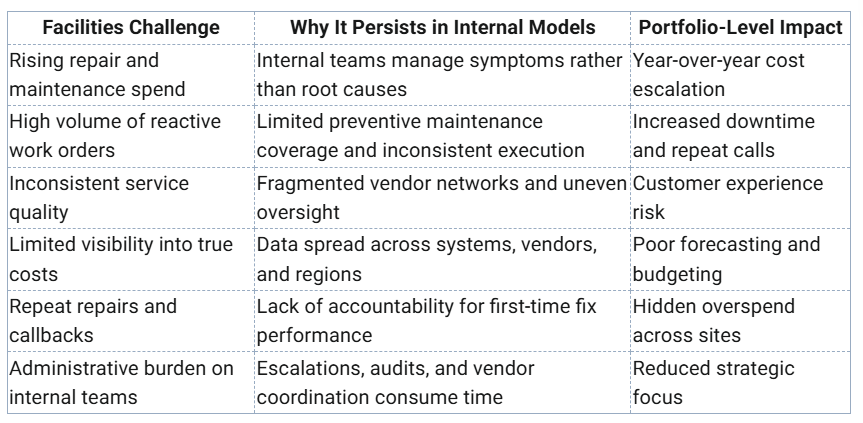
Outsourcing as a Structural Cost Control Lever
Outsourcing facilities management works when it changes the structure of how work is managed, not just who performs it.
A true facilities management partner assumes responsibility for coordinating service delivery, enforcing standards, auditing invoices, and turning data into action. McKinsey research on outsourcing across operational functions shows that organizations achieve the greatest savings when outsourcing reduces complexity and variability, not just headcount. Facilities management fits this profile precisely. Source: McKinsey & Company, The Value of Strategic Outsourcing
When facilities programs are outsourced effectively, organizations gain:
- Reduced work order volume through preventative maintenance and root cause resolution
- Faster resolution times that limit downtime and secondary damage
- Consistent service quality across locations
- Improved visibility into true portfolio-level cost drivers
- Relief for internal teams to focus on strategy rather than escalation
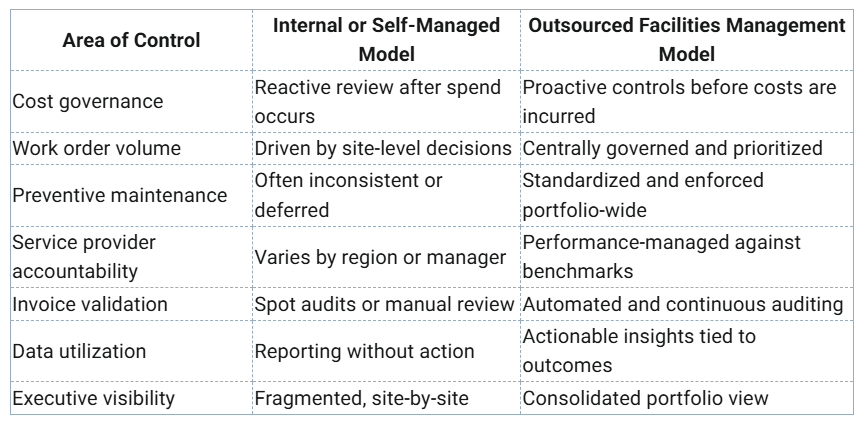
Internal Facilities Management vs. Outsourced Facilities Management
Why Not All Outsourcing Delivers Results
Outsourcing does not automatically lead to cost control. In fact, poorly structured outsourcing programs can increase spend.
Common failure points include fragmented vendor models, lack of invoice auditing, limited data transparency, and no accountability for repeat failures. Simply handing work to large regional or national providers without active management often shifts costs rather than reducing them.
Gartner research has shown that outsourcing initiatives fail to deliver expected savings when governance and performance management are weak. Facilities management is no exception.
Source: Gartner, Outsourcing Governance Best Practices
The difference between success and failure is not outsourcing itself. It is how the outsourcing model is designed, governed, and enforced.
What Effective Facilities Outsourcing Looks Like
High-performing outsourced facilities programs share several traits:
- Centralized intake and dispatch to control work order flow
- Strong preventative maintenance programs to reduce reactive volume
- Invoice auditing that validates labor, parts, and time on site
- Data that highlights trends, outliers, and repeat issues
- Accountability for service providers tied to performance metrics
- Portfolio-wide visibility rather than site-by-site firefighting
Why Core Competency Matters
The most important question executives should ask is not “Should we outsource?” but “Who is best equipped to manage this complexity?”
Facilities management is Vixxo’s core competency. Managing assets, service providers, costs, and performance across large, distributed portfolios is what Vixxo does every day. That focus allows clients to redirect internal energy toward growth, customer experience, and operational priorities that truly differentiate their brand.
Outsourcing facilities management is not about giving up control. It is about gaining it.
FAQs
What types of companies benefit most from outsourcing facilities management?
Multi-site retailers, restaurants, grocers, and convenience store operators with distributed assets benefit the most due to scale, complexity, and variability across locations.
Does outsourcing facilities management reduce costs immediately?
Some savings appear quickly through invoice auditing and controlled dispatch, but the largest gains typically come over time through reduced repair volume and improved asset performance.
Is outsourcing facilities management just a cost play?
No. While cost control is critical, effective outsourcing also improves uptime, service consistency, and internal team efficiency, which directly supports revenue and brand performance.
Want to talk facilities?
Leave a comment or question below and we'll reach out!