
Multi-site facilities leaders are under pressure from both sides. Customer expectations are rising, while Direct Store Operating Expense (DSOE) continues to climb. Over the past two years, DSOE increased 12.7%, with repairs and maintenance up 17.3%. Data sourced from the NACS State of the Industry Report 2024.
Most organizations are overspending 8-15% on their facilities programs.
The issue is not hourly labor rates. It is hidden leakage across callbacks, duplicate work orders, invoice overcharges, and outlier sites.
Use the TCO calculator below to quantify that leakage and model your true Total Cost of Ownership opportunity.
What Is Total Cost of Ownership in Facilities
Total Cost of Ownership, or TCO, includes every cost tied to asset performance across its lifecycle. That means:
- Labor
- Parts and materials
- Trip charges
- Repeat visits
- Asset downtime
- Premature replacement
Making decisions based on labor rate alone is insufficient. In fact, higher hourly rates often result in lower total invoice cost when first-time fix, labor duration, and parts accuracy are controlled.
A TCO calculator shifts the conversation from rate negotiation to outcome management.
The calculator above quantifies four common drivers of facilities overspend:
- Reactive leakage
- Models avoidable spend from callbacks and duplicate work orders. - Invoice overcharges
- Applies conservative assumptions to materials and labor expansion that often go unchallenged. - Outlier site concentration
- Calculates the disproportionate impact of high-cost locations on portfolio spend. - Portfolio-level ROI
- Aggregates modeled savings and compares them to program investment to calculate TCO improvement.
These are not theoretical assumptions. They are patterns repeatedly observed across large, distributed portfolios.
Sample Portfolio Output
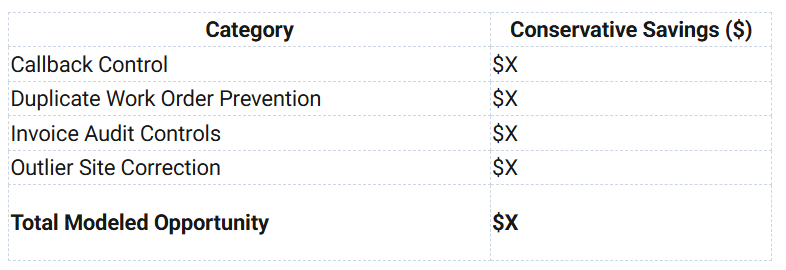
ROI Percentage:
(Total Savings − Program Startup Cost) ÷ Program Startup Cost
Most multi-site portfolios modeled conservatively land between 8-15% total reactive savings when applying structured controls and performance management.
How Facilities Leaders Should Use This Calculator
This calculator is not just a budgeting exercise. It is a strategic planning tool.
Use it to:
- Quantify overspend before renewal cycles
- Justify investment in audit and cost-control programs
- Build a business case for consolidating vendors
- Support capital reinvestment decisions
When maintenance spend is rising faster than revenue, incremental rate negotiation will not close the gap. Structured TCO management will.
Frequently Asked Questions
Why isn’t labor rate the biggest driver of facilities cost?
Hourly rate is only one component of total invoice cost. Trip frequency, labor duration, repeat visits, materials markup, and uncontrolled outlier sites typically have a greater impact on Total Cost of Ownership than negotiated rates alone.
How accurate is this TCO calculator?
The calculator applies conservative assumptions based on observed multi-site portfolio patterns, including callbacks, duplicate work orders, invoice expansion, and outlier concentration. While results vary, many organizations identify 8–15% reactive savings when structured controls are implemented.
What should I do if my results show high overspend?
If the calculator identifies significant leakage, the next step is a portfolio-level review to validate assumptions, analyze invoice detail, and identify high-impact control opportunities.
Want to talk facilities?
Leave a comment or question below and we'll reach out!