

Why Vendor Oversight, Not Rate Negotiation, Determines Total Cost of Ownership
Facilities leaders negotiate hard on labor rates.
But many organizations are still overspending by double digits.
Why?
Because the real problem is not rate. It is value leakage.
Industry research shows that 63% of companies believe they lose an average of 25% of contract value due to poor vendor management. That loss rarely shows up as a single large invoice. It accumulates quietly across thousands of work orders.
In multi-site facilities portfolios, value leakage is one of the most significant drivers of Total Cost of Ownership (TCO).
Key Takeaways for Facilities Leaders
- 63% of organizations believe they lose 25% of contract value due to weak vendor oversight.
- Value leakage occurs when the value expected from a vendor contract does not equal the value realized.
- Lower hourly rates often mask expanded labor durations, materials markups, and repeat dispatches.
- Invoice opacity and weak validation processes create uncontrolled cost expansion.
- Strong governance, performance accountability, and automated invoice auditing are critical to preventing leakage.
Defining Value Leakage in Facilities Management
Value Leakage = Value Expected – Value Realized
In facilities outsourcing, this gap appears when performance, billing, and execution fail to align with contractual intent.
Facilities teams often focus on negotiated rates and assume savings are embedded. However, if labor hours expand, materials are marked up aggressively, or repeat calls increase, total cost rises despite favorable rate cards.
Value leakage is not usually malicious. It is systemic.
Common Sources of Value Leakage
- Expanded Labor Durations
Lower hourly rates may be offset by increased time on site or multiple technicians assigned unnecessarily. - Materials Markup Expansion
Parts pricing is frequently loaded into materials categories with limited transparency, masking overcharges. - Duplicate or Overlapping Work Orders
A second dispatch for the same asset within 30 days should trigger scrutiny. Without recall tracking, it often does not. - Inaccurate Invoicing
Lack of check-in compliance, IVR validation, or photo documentation weakens billing accountability. - Unrealistic Guaranteed Savings Contracts
Savings models that rely on rate compression without operational governance often fail to deliver sustainable TCO reduction. - Over-Prioritization of Emergencies
Excessive P1 or emergency classifications drive overtime, expedited parts, and inflated trip charges.
Why Rate Negotiation Does Not Solve Leakage
Hourly labor typically represents only 30–40% of total work order cost. The remaining 60–70% is influenced by:
• Time on site
• Parts and materials pricing
• Repeat visits
• Trip charges
• Scope creep
• Administrative inefficiencies
Organizations that select vendors based on lowest rate without performance controls often see total spend increase year over year.
Perception of control does not equal actual control.
How Leakage Impacts Multi-Site Portfolios
Across distributed portfolios, small inefficiencies scale quickly.
Example Portfolio Impact
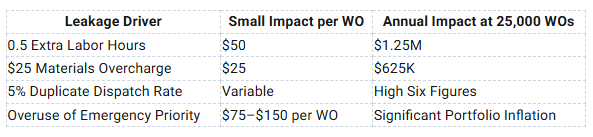
When multiplied across thousands of locations, leakage becomes a seven-figure problem.
Operational Controls That Prevent Value Leakage
Facilities leaders focused on TCO must implement structured controls that close the gap between expected and realized value.
Critical Governance Controls
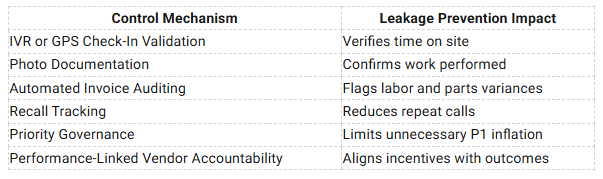
Without these controls, even well-negotiated contracts drift.
Transparency Is a Strategic Advantage
Organizations that centralize asset data, invoice validation, and performance oversight consistently outperform peers.
Programs that implement structured governance frequently achieve:
• 15–25% improvement in on-demand maintenance cost
• 13–15% improvement in scheduled maintenance cost
• Reduced emergency dispatch frequency
• Improved first-time fix rates
• Stabilized work order volume
Value leakage prevention is not about squeezing vendors. It is about creating alignment between performance and cost.
The Role of Asset Visibility
Asset opacity fuels leakage.
When facilities teams lack visibility into asset age, repair frequency, and lifecycle cost trends, reactive dispatch becomes the default.
Centralized asset management enables:
• Root cause analysis
• Preventive maintenance optimization
• Strategic replacement planning
• Volume reduction
Reducing repair volume is more impactful than compressing rates.
From Vendor Management to Performance Partnership
The most effective facilities programs move beyond vendor selection to performance governance.
This includes:
• Defined SLAs tied to measurable KPIs
• Standardized business rules
• Invoice validation embedded into workflow
• Continuous performance measurement
• Data-driven asset strategy
In mature TCO models, vendors are held accountable not just for cost per hour, but for total portfolio outcomes.
The Bottom Line
Value leakage is rarely visible in isolation. It accumulates across:
• Small invoice discrepancies
• Repeat service calls
• Inefficient dispatch
• Unvalidated labor
• Weak asset data
Facilities leaders who shift focus from rate negotiation to systemic governance unlock measurable, sustainable savings.
Preventing value leakage is not a finance exercise.
It is an operational discipline.
FAQs
What is value leakage in facilities management?
Value leakage occurs when the cost savings or performance outcomes expected from a vendor contract are not fully realized due to billing inefficiencies, repeat work, weak oversight, or misaligned incentives.
How much impact can value leakage have?
Industry data suggests that organizations may lose up to 25% of contract value due to poor vendor management, especially in large multi-site portfolios.
How can facilities teams prevent invoice overcharges?
Implementing automated invoice auditing, IVR or GPS check-in validation, recall tracking, and performance-linked vendor accountability significantly reduces leakage risk.
Is negotiating a lower labor rate enough to control cost?
No. Labor rate typically represents only 30–40% of total work order cost. Duration, materials, repeat visits, and priority inflation often have greater financial impact.
Want to talk facilities?
Leave a comment or question below and we'll reach out!