
.png?width=615&height=346&name=Article%20Images%20(4).png)
Second visits rarely raise alarms.
They should.
Across multi-site facilities portfolios, second truck rolls are one of the most underestimated drivers of Total Cost of Ownership (TCO). They often feel routine, even unavoidable. But when they become common, they quietly reshape cost, downtime, and operational strain in ways that never show up on a single invoice.
That is where TCO starts to break down.
Why Second Visits Happen More Than Teams Expect
Second visits are almost never planned.
They are the byproduct of fragmented execution. Incomplete scopes of work, approval delays, tight not-to-exceed limits, unavailable parts, or insufficient trade specialization all lead to the same outcome: work stops before resolution.
The technician leaves.
The asset remains compromised.
The issue returns later.
Sometimes days later. Sometimes weeks.
On paper, the original work order may still look controlled. In reality, the cost has already started to compound.
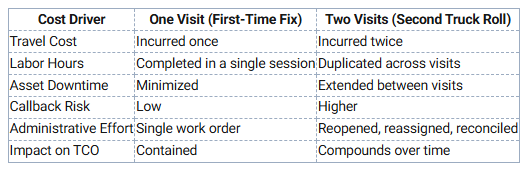
Travel and Labor Duplication Multiply Cost
Every additional visit duplicates effort that delivers no new value.
Travel is billed again. Labor hours repeat. Administrative work increases as teams reopen tickets, reassign providers, and reconcile multiple invoices tied to the same issue. Even when labor rates stay flat, total labor exposure grows.
A repair that could have been completed in one visit but instead requires two rarely costs “a little more.” It costs materially more -- and that difference compounds quickly across hundreds or thousands of locations.
Downtime Is the Cost That Never Waits
The most expensive consequence of second visits is not labor. It's downtime.
While teams wait for approvals, parts, or return visits, assets remain partially functional or fully offline. In revenue-generating environments like convenience stores, grocery, and retail, that downtime impacts sales, labor efficiency, and customer experience in real time.
Downtime does not pause because a technician has left the site.
It continues until the problem is fully resolved.
That lost time is rarely captured in maintenance metrics. It should be.
Second Visits Increase Callback Risk
Second visits also raise the probability of callbacks.
Temporary fixes, incomplete repairs, or rushed follow-up work often fail to address root causes. The same asset generates another work order. Then another. Over time, certain locations quietly become repeat offenders.
Average cost per work order may still look acceptable.
Total spend does not.
This is one of the most common TCO blind spots in facilities management: stable averages masking rising volume.
The Administrative Burden Adds Up
There is also the cost no one budgets for.
Each second visit adds friction. Facilities teams spend more time coordinating approvals, communicating with store teams, tracking progress, and resolving invoice discrepancies. None of this appears as a line item, but all of it consumes capacity.
As second visits increase, teams feel stretched even when headcount and budgets remain unchanged.
That strain is a cost.
Reducing Second Visits Is a TCO Strategy
High-performing facilities organizations treat second visits as a signal, not an inevitability.
Reducing them requires prioritizing first-time fix rates, enabling faster decisions in the field, bundling work where possible, and aligning execution to outcomes rather than invoice thresholds. The objective is simple: complete the work once, correctly.
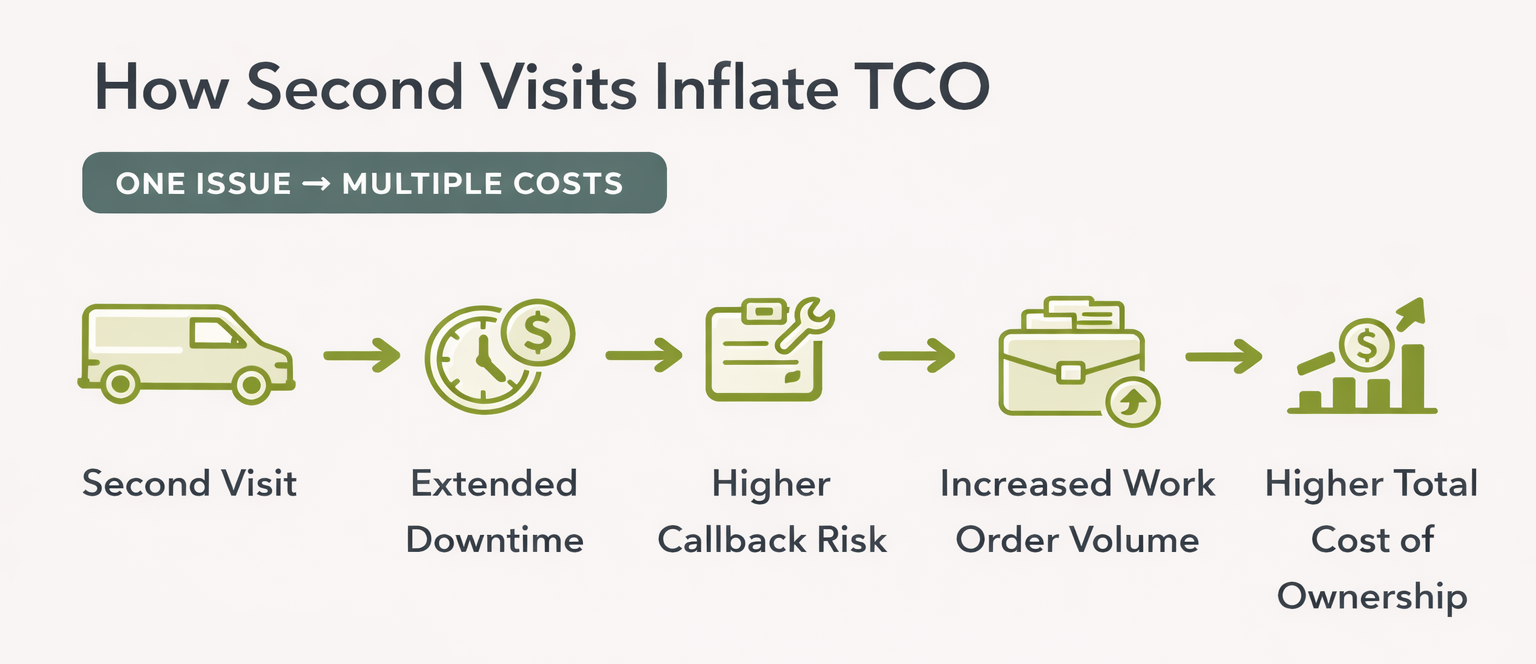
When repairs are completed in a single visit, travel duplication drops, downtime shrinks, callbacks decline, and administrative burden eases. Cost control improves not because invoices are smaller, but because fewer invoices are needed.
At Vixxo, this execution-first approach is central to managing Total Cost of Ownership. By combining expertise, visibility, and accountability, facilities teams can reduce second visits and control cost where it actually accumulates.
Second visits may feel routine.
Their impact on TCO is anything but.
FAQs
Why are second visits so costly in facilities management?
They duplicate travel and labor, extend downtime, increase callbacks, and add administrative burden that is rarely tracked or budgeted.
How do second visits affect Total Cost of Ownership?
They increase work order volume, prolong asset downtime, and drive higher long-term spend even when individual invoices appear controlled.
How can facilities teams reduce second visits?
By improving first-time fix rates, enabling faster approvals, bundling work, and managing execution based on total cost rather than invoice price alone.
Want to talk facilities?
Leave a comment or question below and we'll reach out!