

.png?width=615&height=346&name=Article%20Images%20(5).png)
Grocery facilities operations are entering a new era of complexity. Fresh departments, refrigeration-intensive environments, and prepared foods are now central to the customer experience and the profit model. At the same time, margins remain tight, labor is constrained, and tolerance for downtime is effectively zero.
That combination is forcing grocery executives to rethink how facilities work actually gets done.
Across the industry, leaders are shifting the outsourcing conversation from cost control to operational resilience. That shift is especially visible as grocery executives gather at StorePoint Fresh to compare notes on what is working, what is not, and where internal models are starting to break down.
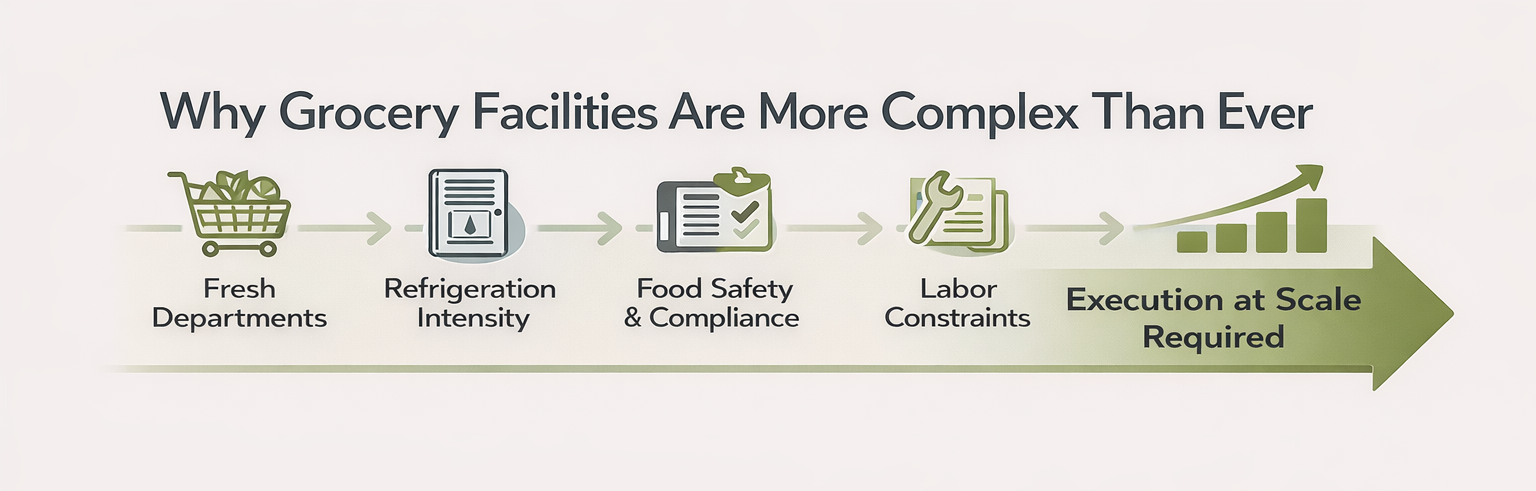
As facilities complexity increases, many grocery organizations are discovering the limits of fragmented, in-house execution models.
Fresh Departments Raise the Stakes for Facilities Execution
Fresh is no longer a perimeter category. It is a traffic driver.
Produce, meat, seafood, deli, bakery, and prepared foods all rely on tightly controlled environments. Refrigeration uptime, temperature accuracy, and response speed are directly tied to food safety, shrink, and brand trust. According to the Food Industry Association (FMI), refrigeration remains one of the most critical and cost-intensive systems in grocery operations, impacting both energy spend and product integrity.
In these environments, facilities failures are not minor inconveniences. A refrigeration issue can escalate into product loss, regulatory exposure, and lost customer confidence within hours.
That reality changes the outsourcing equation.
Why In-House Models Are Under Strain
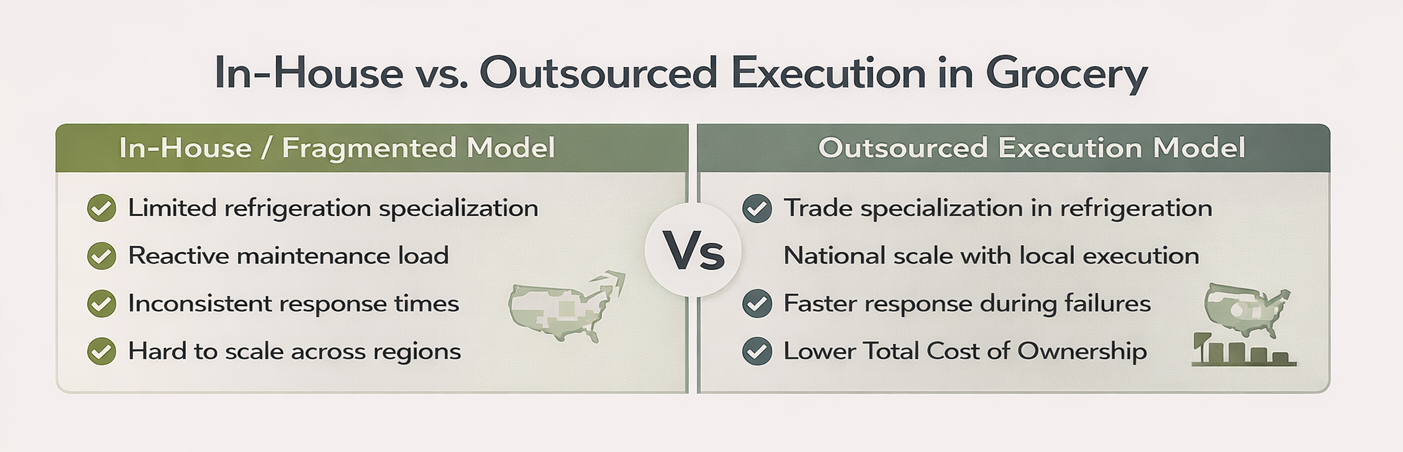
Many grocery organizations still rely heavily on internal teams supplemented by local vendors. That model worked when stores were simpler and failure tolerance was higher. It is far less effective today.
Fresh departments require specialized trade expertise. Refrigeration systems are more complex. Compliance expectations are higher. Internal teams are stretched thin managing reactive work, while planned maintenance and root cause fixes get deprioritized.
The result is a cycle grocery leaders know well. More emergency calls. More callbacks. More downtime. And more spend that is difficult to control.
Technology platforms may provide visibility, but visibility alone does not fix a case, stabilize a rack, or restore a cooler.
How Outsourcing Has Evolved for Grocery
Modern facilities outsourcing in grocery looks very different than it did a decade ago.
It is no longer about handing off work and hoping for lower rates. It is about execution at scale. National coverage with local expertise. Trade specialization in refrigeration and fresh systems. Accountability tied to uptime, not just invoices.
This evolution is why grocery leaders are asking different questions. Not should we outsource, but how do we ensure outsourced execution actually protects food safety, reduces downtime, and lowers Total Cost of Ownership.
Why This Conversation Is Front and Center at StorePoint Fresh
StorePoint Fresh has become a forum where grocery executives are openly comparing operational strategies. Conversations are centered on fresh execution, refrigeration reliability, labor gaps, and the need for partners that can operate consistently across distributed portfolios.
Facilities strategy is no longer a back-office decision. It is a leadership issue.
At Vixxo, we see this shift firsthand. Supporting grocery brands across fresh, refrigeration, HVAC, and critical trades requires more than dispatch. It requires a coordinated execution model designed to keep stores open, food safe, and customers confident.
Outsourcing is no longer about cost avoidance. For grocery leaders in 2026, it is about continuity.
FAQs
Why are fresh departments driving changes in facilities strategy?
Because fresh categories depend on refrigeration uptime and rapid response, making facilities performance directly tied to revenue, food safety, and brand trust.
What facilities systems are most critical in grocery environments?
Refrigeration, HVAC, electrical, and food equipment systems are the most critical due to their impact on safety, compliance, and shrink.
Why are grocery leaders revisiting outsourcing now?
Labor constraints, system complexity, and the rising cost of downtime are pushing leaders to seek execution models that deliver consistent outcomes at scale.
Want to talk facilities?
Leave a comment or question below and we'll reach out!