
.png?width=615&height=346&name=Article%20Images%20(15).png)
If you’re responsible for facilities across multiple sites, you’ve probably learned this the hard way: the cheapest fix today can cost you more tomorrow.
Lower total cost of ownership (TCO) doesn’t come from cutting corners. It comes from preventing failures, using data wisely, and knowing when to repair—and when to replace.
Here’s how smart facility teams reduce lifecycle costs without sacrificing uptime.
What TCO Really Includes
TCO isn’t just repair spend. It’s every dollar an asset consumes over its life.
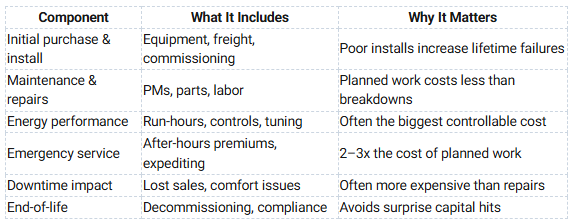
The goal? Shift spending away from unpredictable emergencies and toward predictable, value-driven maintenance.
The Fastest Way to Lower Lifecycle Costs
Move from reactive to disciplined.
Here’s what works:
- Align PMs to OEM standards and site risk
- Prioritize work by asset criticality—not FIFO
- Stock high-failure spare parts (belts, filters, contactors)
- Standardize work-order routing across sites
- Capture photos, readings, and asset history every visit
- Review repeat failures monthly and assign root cause actions
Emergency-heavy programs drain budgets. Planned programs protect them.
Technology Is the Multiplier
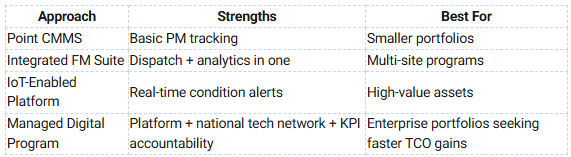
A modern CMMS or FM platform centralizes assets, work orders, dispatch, and analytics so teams fix the right things at the right time.
What leading platforms deliver:
- Automated dispatch based on trade, SLA, and geography
- Real-time asset histories via QR codes
- Mobile tools for techs in the field
- Inventory visibility across sites
- ERP and building system integrations
Here’s how different approaches stack up:
Preventive + Predictive = Smart Maintenance
Preventive maintenance handles the fundamentals—filters, belts, lubrication.
Predictive maintenance uses vibration, thermography, amperage trends, and analytics to catch issues before failure.
- Use preventive for standard assets.
- Blend predictive for mission-critical equipment.
- If telemetry shows drift—act early.
That’s how you extend life instead of replacing early.
Measure What Matters
You can’t improve what you don’t track.
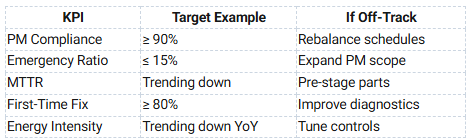
Monthly reviews keep maintenance sharp. Quarterly reviews inform capital timing.
Choosing the Right Partner
The right facilities partner doesn’t just fix things. They:
- Provide nationwide trade coverage
- Operate on a centralized digital platform
- Deliver transparent reporting
- Tie performance to outcome-based KPIs
- Shift work from reactive to preventive
That’s how portfolios reduce emergency ratios, improve first-time fix rates, and make smarter capital decisions.
Bottom line:
The lowest TCO isn’t about spending less. It’s about spending smarter—before failure forces your hand.
And the teams that win are the ones who plan for it.
Frequently Asked Questions
Why isn’t the lowest service rate the best TCO option?
Lower hourly rates can lead to more emergencies, repeat failures, and shorter asset life. True TCO performance comes from prevention and data-driven decisions.
How does preventive maintenance reduce costs?
It fixes small issues before they become expensive failures, reducing emergency calls and extending equipment life.
When should predictive maintenance be used?
Use predictive tools for high-value or mission-critical assets where failure risk carries major cost or downtime impact.
Which KPIs matter most for lowering TCO?
Track PM compliance, emergency-to-planned ratio, MTTR, first-time fix rate, and energy intensity to measure lifecycle performance.
What should I look for in a facilities management partner?
Look for nationwide coverage, digital transparency, strong SLAs, and proven ability to reduce emergency work and improve asset longevity.
Want to talk facilities?
Leave a comment or question below and we'll reach out!