

Key Takeaways
- Repair and maintenance costs in convenience have risen 13.7% in 2022 and 5.2% in 2023, putting pressure on already thin margins
- Reducing work order volume is more powerful than negotiating lower hourly rates
- Predictive maintenance must combine AI, human oversight, and provider accountability
- Technology alone does not reduce spend. Actionable insight does
The Real Question Behind “Best Predictive Maintenance”
When facilities leaders search for the best predictive maintenance analytics for building operations, they are not asking about dashboards.
They are asking:
Who reduces emergency calls?
Who lowers repeat repairs?
Who protects refrigeration, HVAC, and foodservice uptime?
Who turns data into real cost control?
In convenience, this matters more than ever. Foodservice now drives 39.6% of in-store gross margin dollars. At the same time, Direct Store Operating Expense continues to climb, with repair and maintenance among the fastest growing categories.
Predictive maintenance is no longer optional. It is a margin strategy.
Where Most Programs Break Down
Many organizations rely on a Computerized Maintenance Management System, or CMMS, expecting visibility to equal control.
But data without intervention creates reporting, not savings.
Common failure points across multi-site c-store portfolios include:
Callbacks within 30 days
Duplicate or overlapping work orders
Outlier stores driving disproportionate spend
PM visits that fail to prevent near-term breakdowns
In one multi-site assessment, 10% of stores drove 25% of total spend. Callback and duplicate work orders represented over 40% of reactive volume in certain trades.
Those are predictive signals. If your platform does not flag them in real time, you are reacting.
Why Volume Reduction Beats Rate Negotiation
Facilities leaders often focus on lowering hourly labor rates. But total cost of ownership tells a different story.
Below is a simplified comparison model:
Total Cost Comparison Per Work Order
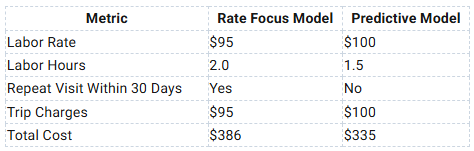
A slightly higher labor rate can result in lower total cost when duration, parts pricing, and recalls are controlled.
Predictive maintenance analytics must focus on:
Reducing repair duration
Eliminating duplicate dispatches
Preventing recalls
Identifying aging assets before repeated failure
What Predictive Maintenance Looks Like in Convenience
C-stores operate complex, revenue-critical assets:
Refrigeration protecting perishable inventory
HVAC systems driving comfort and compliance
Bean-to-cup coffee and fresh food equipment
Fuel systems directly tied to top-line revenue
Unplanned maintenance can cost 3 to 9 times more than planned maintenance. In energy case studies, locations performing structured maintenance saw energy cost reductions of 16% or more in year one.
Predictive maintenance should answer four operational questions:
- Which stores are trending toward failure?
- Which assets are past economic repair life?
- Which providers are driving repeat volume?
- Where is labor duration exceeding norms?
If your analytics cannot answer those, it is not predictive.
What “Best” Predictive Analytics Requires
The strongest predictive maintenance strategies combine:
People
Dedicated program management reviewing trends weekly
Process
Recall tracking, duplicate work order controls, priority restructuring
Technology
AI-driven invoice validation, duration audits, parts benchmarking
Insight
Portfolio-level benchmarking and outlier identification
For example, AI-powered invoice audit tools can detect excess labor hours, inflated materials, and mismatched time on site versus time billed. In the past 12 months, structured invoice audit programs have driven millions in direct cost avoidance across multi-site portfolios.
That is predictive analytics in action.
So Who Has the Best Predictive Maintenance Analytics?
For convenience operators, the best predictive maintenance partner is not just a software provider. It is one that combines scale, AI, and active program management.
Vixxo’s model integrates:
- AI-driven invoice validation that flags labor expansion and materials overcharges in real time
- Duplicate and recall detection that reduces avoidable work order volume
- Provider scorecarding and performance management
- Outlier store identification to target the 10% of sites driving disproportionate spend
- Field-level AI tools that improve first-time fix rates and reduce truck rolls
Vixxo supports over 2 million assets across North America and applies cross-portfolio benchmarking to every client environment. That density creates leverage with providers and deeper predictive insight across refrigeration, HVAC, foodservice equipment, and exterior assets.
The result is not just data visibility. It is controlled dispatch, reduced volume, and measurable Total Cost of Ownership reduction.
Predictive Maintenance Impact Snapshot

Facilities leaders should not be asking who has the best dashboard.
They should be asking:
- Who reduces volume?
- Who protects uptime?
- Who lowers total cost of ownership across refrigeration, HVAC, and foodservice?
That is the difference between predictive reporting and predictive performance.
FAQs
What is predictive maintenance analytics for convenience stores?
It is the use of asset data, repair history, invoice validation, and trend analysis to anticipate failures, reduce repeat work orders, and optimize maintenance timing before breakdowns occur.
How does predictive maintenance reduce cost?
By lowering repair volume, preventing callbacks, auditing labor and materials in real time, and identifying high-risk assets before emergency failure.
Is predictive maintenance better than a CMMS alone?
Yes. A CMMS provides data capture. Predictive maintenance requires analytics, intervention, and provider accountability layered on top of that data to drive measurable cost and uptime improvement.
Want to talk facilities?
Leave a comment or question below and we'll reach out!