

.png?width=615&height=346&name=Article%20Images%20(13).png)
Retail facilities leaders face rising pressure from tighter energy codes, electrification mandates, and customer comfort expectations. By 2026, the lowest total cost of ownership (TCO) for HVAC and MEP systems will not come from chasing equipment efficiency alone. In commercial buildings, operational costs such as energy, maintenance, and repairs typically account for 70 – 80 % of lifecycle cost, meaning upfront equipment price is just the tip of the iceberg.
The lowest TCO now comes from pairing the right systems with disciplined design decisions, proactive controls strategy, and portfolio-level operational management. For multi-site retailers, partners that centralize dispatch, standardize controls, and enforce preventive maintenance at scale consistently deliver lower lifecycle costs and tighter budget predictability.
Understanding TCO for HVAC and MEP Equipment
TCO captures every cost an asset incurs across its lifecycle: design, installation, energy, maintenance, controls, compliance, and end-of-life. While upfront equipment cost is often the most visible line item, it represents only a portion of long-term spend.
The table below illustrates how lifecycle costs typically break down for two common retail HVAC approaches:
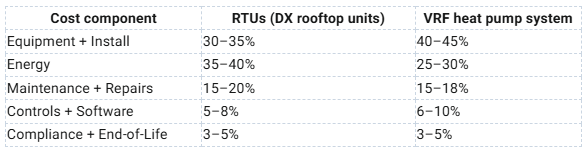
As shown in the TCO comparison chart, energy and service costs now outweigh upfront equipment spend over a 10-year horizon. While rooftop units often win on initial cost, variable refrigerant flow systems and low-temperature heat pumps frequently deliver lower operating costs through zoning, part-load efficiency, and tighter control.
The takeaway is not that one system always wins, but that the lowest TCO comes from matching system type to footprint, validating loads early, and managing performance continuously.
Key Low-Cost HVAC and MEP Strategies for Retail Facilities
Winning on TCO starts before procurement. High-performing portfolios consistently apply the following practices:
- Validate loads with hour-by-hour simulation to avoid oversizing
- Standardize controls, sensors, and user interfaces across store types
- Deploy reversible heat pumps or VRF where zoning and electrification matter
- Use prefab or modular plant rooms to reduce install and commissioning risk
- Tie vendor contracts to measurable outcomes, not just labor rates
The quick-start checklist summarizes these actions for immediate application.
Why Simulation-First Design and Early Controls Decisions Matter
Simulation-first optioneering reduces rework by testing multiple HVAC and MEP scenarios digitally before equipment is selected. This approach prevents oversizing, validates control sequences, and lowers retrofit risk. Equally important, controls and accessories must be specified early. Late-stage controls decisions often lead to higher service calls, user overrides, and performance drift that erodes projected savings.
Operational Practices That Protect Lifecycle Cost
Design intent only delivers savings when operations reinforce it. Preventive maintenance, digital commissioning, and strong contractor governance are essential to reducing emergency repairs and extending asset life. Measurement and verification programs increasingly tie vendor compensation to verified performance, ensuring savings persist beyond installation.
Vixxo’s Approach to Delivering the Best HVAC and MEP TCO
Vixxo aligns design, procurement, and operations into a single, scalable facilities management model. Centralized dispatch, real-time asset analytics, and disciplined preventive maintenance programs reduce avoidable spend while improving uptime across retailers with 100 to 10,000+ locations. By standardizing execution nationally while preserving local responsiveness, Vixxo helps retailers convert HVAC and MEP investments into predictable, measurable lifecycle value.
Frequently Asked Questions
How do I assess HVAC needs for a retail facility?
Start with load calculations based on layout, occupancy, and operating hours, then validate options through simulation.
What HVAC systems are most cost-effective for retail?
RTUs suit simple layouts, while VRF and heat pumps often deliver lower lifecycle cost where zoning and long hours matter.
How can retailers meet 2026 energy standards affordably?
Right-size equipment, standardize controls, leverage incentives, and enforce preventive maintenance at scale.
Want to talk facilities?
Leave a comment or question below and we'll reach out!