

Key Takeaways
- IFM success in 2026 is defined by measurable outcomes like uptime, cost control, and customer experience, not task completion.
- Unified technology and predictive maintenance are critical to reducing downtime, lowering costs, and improving portfolio visibility.
- The right IFM partner differentiates through execution, data transparency, and the ability to deliver consistent results at scale.
Integrated facility management (IFM) is evolving from vendor coordination to outcome orchestration across large, distributed portfolios. In 2026, leading organizations are prioritizing unified platforms, predictive maintenance, and measurable performance models that drive uptime, cost control, and customer experience. Market forecasts point to an 8–10% CAGR, with North American IFM expected to surpass $60B by 2028, reinforcing the urgency for facilities leaders to modernize operating models.
For multi-site operators, success depends less on who is “top rated” and more on who can integrate data, scale execution, and deliver measurable outcomes. Vixxo’s approach combines portfolio-level analytics, transparent cost structures, and integrated trade expertise to align facilities performance with business goals.
Strategic Overview
IFM adoption continues to accelerate across retail, grocery, restaurant, and convenience store environments as organizations seek centralized visibility and operational consistency. Growth is driven by rising operating costs, labor constraints, and increasing complexity across assets and trades.
The shift is clear: facilities is no longer a decentralized function. It is a data-driven operating system that requires alignment across finance, operations, and field execution.
The Shift to Outcome-Driven IFM
Outcome-driven IFM aligns performance to business results such as uptime, energy efficiency, and customer experience rather than task completion.
For large-scale portfolios, this shift enables:
- Unified KPIs across trades and regions
- Clear linkage between spend and operational outcomes
- Executive-level visibility into performance drivers
- Continuous improvement through measurable accountability
This evolution reduces fragmentation and ensures facilities programs contribute directly to revenue protection and cost control.
Technology Integration as the Foundation for IFM Success
Modern IFM requires a connected technology ecosystem. An Integrated Workplace Management System (IWMS) or Computer-Aided Facility Management (CAFM) platform becomes the backbone for visibility, workflow automation, and analytics.
Comparison of IWMS and CAFM capabilities
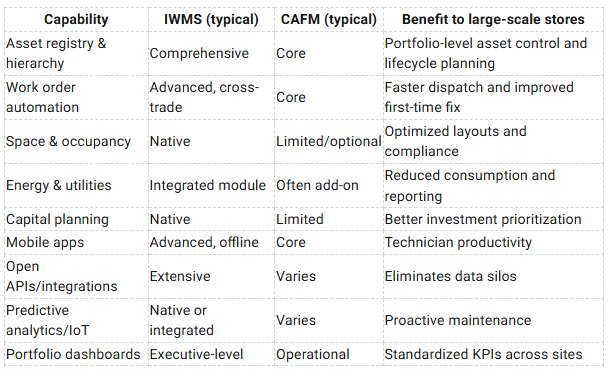
Recommended approach: prioritize open architecture platforms that enable data flow across facilities, finance, and operations.
Predictive Maintenance and IoT-Enabled Asset Management
Predictive maintenance is becoming a primary lever for cost reduction and uptime improvement. By leveraging IoT sensors and real-time data, organizations can detect failures early and reduce unnecessary service events.
High-impact asset categories include:
- HVAC systems
- Refrigeration equipment
- Lighting and controls
- Foodservice equipment
- Electrical and backup systems
Preventive and predictive strategies are critical given that reactive maintenance can cost 3–9x more than planned maintenance, reinforcing the need to shift from break-fix models to proactive programs.
Energy, Sustainability, and Compliance
Energy and compliance are now core operational priorities. Facilities leaders are expected to manage consumption, meet regulatory requirements, and report on Environmental, Social, and Governance (ESG) performance.
Best practices include:
- Embedding energy KPIs into performance reporting
- Automating data capture and exception alerts
- Aligning vendor performance to energy outcomes
Key metrics to track:
- Energy intensity (kWh per sq. ft.)
- Refrigerant management
- Carbon footprint (Scopes 1 and 2)
- Waste diversion rates
- Indoor air quality metrics
Integrating these metrics into facilities programs ensures compliance while identifying cost-saving opportunities.
Workforce Transformation Through Automation
Labor constraints continue to challenge facilities organizations. Automation, mobile enablement, and structured training programs are essential to maintaining service quality and consistency.
Effective programs focus on:
- Role-based training tied to technology adoption
- Mobile tools for real-time data capture
- Performance dashboards for ongoing coaching
- Continuous upskilling aligned to evolving systems
Technology alone is not sufficient. Execution depends on combining tools with trained teams and standardized processes to drive consistent outcomes.
Outcome-Based Contracting and Performance Verification
Outcome-based contracting links spend directly to measurable results. This model improves accountability and stabilizes operating costs.
Key components include:
- Standardized KPIs across the portfolio
- Real-time verification through mobile tools and reporting
- Incentives tied to uptime, energy, and service quality
This approach shifts facilities from a cost center to a performance-driven function.
Balancing Cost Control with Strategic Investment
Facilities leaders must balance short-term cost pressure with long-term asset performance. While digital transformation requires upfront investment, the return is realized through reduced downtime, lower energy costs, and improved asset lifespan.
A disciplined approach includes:
- Quantifying downtime and energy impact
- Piloting high-value initiatives before scaling
- Prioritizing investments based on ROI and risk
- Reinvesting savings into continuous improvement
Organizations that take a lifecycle view consistently outperform those focused only on immediate cost reduction.
Vendor Selection Criteria for Large-Scale Portfolios
Selecting the right IFM partner requires an evidence-based approach focused on scalability, transparency, and execution capability.
Comparative evaluation framework
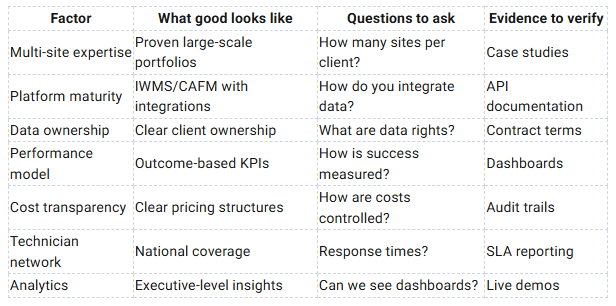
Vixxo’s model combines national scale, real-time analytics, and cost control discipline to help organizations reduce spend while improving uptime across complex portfolios.
Centralized Visibility and Real-Time Execution
Centralized platforms provide real-time visibility into work orders, asset performance, and technician activity across all locations. This enables faster decision-making and improved accountability.
For large portfolios, visibility is critical to:
- Identify cost drivers and outliers
- Standardize performance across regions
- Improve response times and service quality
Frequently Asked Questions
What is integrated facility management (IFM)?
IFM is a centralized approach to managing facilities services across multiple locations, combining technology, vendor coordination, and performance management into a single operating model.
How does predictive maintenance reduce costs?
Predictive maintenance identifies issues before failure, reducing emergency repairs, minimizing downtime, and extending asset life, which lowers total cost of ownership.
What should facilities leaders prioritize when selecting an IFM partner?
Focus on data integration, multi-site execution capability, transparent pricing, and the ability to deliver measurable outcomes tied to uptime and cost control.
How do outcome-based contracts improve performance?
They align incentives with results such as uptime and energy savings, ensuring accountability and driving continuous improvement.
Why is data governance important in IFM?
Strong data governance ensures accurate insights, prevents vendor lock-in, and enables better long-term decision-making across the facilities portfolio.
Want to talk facilities?
Leave a comment or question below and we'll reach out!