
Facilities Management | Beverage Equipment | Convenience Stores | Quick Service Restaurants
Iced coffee. Cold foam lattes. Specialty frozen beverages. Handcrafted tea drinks. What was once a niche daypart add-on has become the single most competitive battleground in convenience and quick service restaurant (QSR) foodservice. And for facilities directors, it has become one of the most operationally demanding categories to keep running.
The numbers are hard to ignore. According to NACS Convenience Voices, foodservice and packaged beverages together accounted for 60.8% of in-store gross profit dollars in 2024. Beverages alone drive 40%-plus net margins, the highest of any in-store category. Cold beverage specifically — iced coffees, specialty drinks, and dispensed cold beverages — sits at the center of that margin story. Nearly half of all c-store trips now include a beverage purchase, and beverage shoppers are among the highest-frequency customers any operator can acquire.
The traffic data from the coffee space reinforces this urgency. Placer.ai's 2025 Coffee Industry Report found that coffee chains saw consistent year-over-year (YoY) quarterly visit growth throughout 2025 even as consumers tightened discretionary spending elsewhere. Brands that delivered fast, reliable, differentiated cold beverage programs captured durable loyalty. Brands that did not lost visits to competitors who did.
For c-store and QSR facilities leaders, the message is direct: cold beverage and specialty drink equipment is revenue-generating infrastructure. It demands the same operational discipline as any other critical asset in the building.
The Equipment Behind the Menu
Specialty cold beverage programs are only as strong as the equipment running them. Across c-store and QSR formats, the most common equipment categories in a modern cold beverage bar include:
| Equipment Type | Function | Downtime Risk |
|---|---|---|
| Bean-to-cup coffee machines | Brewed base for iced and specialty coffees | High — entire iced coffee menu can go offline |
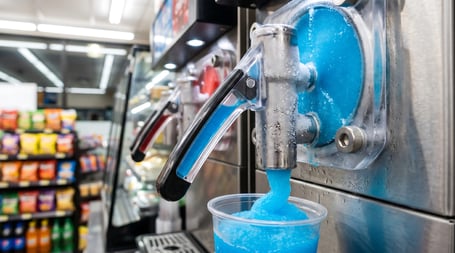
| Frozen/blended beverage dispensers | Slushies, frozen lattes, specialty frozen drinks | High — temperature-sensitive, frequent seals and motor wear |
| Cold brew towers and tap systems | Nitro and still cold brew on demand | Medium — line maintenance and keg system issues |
| Syrup and flavor dispensing systems | Customization for specialty and LTO beverages | Medium — pump failures and clogging during high volume |
| Ice machines and dispensers | Ice supply for every cold beverage category | Critical — no ice means no cold beverage program |
| Reach-in coolers and cold holding | Ready-to-drink (RTD) and cold ingredient storage | High — food safety exposure on failure |
Each piece of this equipment operates under heavy daily cycle counts. A busy c-store or QSR location can run a bean-to-cup machine through hundreds of cycles per day. Frozen beverage dispensers run near-continuously during peak hours. When any single component fails without a rapid response plan, the revenue impact is immediate and measurable.
Preventive Maintenance (PM) Is Not Optional at This Volume
The industry data on preventive maintenance (PM) for food and beverage equipment is consistent: regular servicing extends equipment life, reduces emergency repair costs, and typically stabilizes repair and maintenance (R&M) costs within the first year of a consistent PM program. For cold beverage equipment specifically, the stakes are amplified by sanitation requirements, refrigerant regulations, and the precision demanded by specialty drink recipes.
Vixxo supports more than 3,000 managed bean-to-cup installs, completing 38,900-plus annual repairs and 5,600-plus annual preventive maintenance visits across its c-store and QSR client network. That depth of service data means Vixxo technicians understand the failure patterns, seasonal wear cycles, and model-specific vulnerabilities that most general FM (facilities management) providers simply do not have visibility into.
A broken coffee machine is not just a maintenance issue — as Vixxo's own operational philosophy puts it, it is a customer experience failure. In a category where brands like Scooter's Coffee built traffic leadership specifically by delivering fast, reliable, frictionless experiences, equipment reliability is a direct competitive input.
The Multi-Site Scaling Challenge
Rolling out a new iced beverage or specialty drink program across hundreds of locations is not just a marketing exercise — it is a facilities project. Equipment procurement, installation coordination, electrical and plumbing requirements, staff training readiness, and ongoing service coverage all have to come together consistently across every site for the program to land as intended.
Vixxo has installed 20,000-plus coffee machines across its c-store network, with individual rollouts reaching 2.3 units per site on average — upgrades that directly improved customer satisfaction scores in those programs. Coordinating that kind of scale requires centralized project management, a deep technician network, and the logistics infrastructure to move fast without sacrificing consistency.
For facilities directors navigating a new beverage bar buildout, a bean-to-cup upgrade cycle, or a frozen beverage expansion, the question is not just which equipment to spec — it is who manages the install, who services it on day 366, and what the response time looks like when something fails at 7:00 AM on a Tuesday.
Vixxo's Cold Beverage Expertise by the Numbers
20,000+ coffee machines installed across c-store networks
38,900+ annual bean-to-cup repairs managed
5,600+ annual preventive maintenance visits completed
99%+ equipment uptime delivered across client locations
~30% of U.S. convenience store locations serviced by Vixxo's dedicated c-store team
Sources: Vixxo internal data; NACS Convenience Voices 2024; Placer.ai 2025 Coffee Industry Report
What Facilities Leaders Should Be Asking
If your organization is expanding or upgrading its cold beverage and specialty drink program, these are the operational questions that determine whether the investment delivers:
- What is the mean time to repair (MTTR) for my highest-volume beverage equipment? Every hour offline during a morning rush is direct revenue loss.
- Does my FM provider have equipment-specific expertise, or are they a generalist? Bean-to-cup machines, frozen dispensers, and cold brew systems each have distinct failure modes that require specialized knowledge.
- Are preventive maintenance schedules aligned to cycle counts, not just calendar dates? High-volume locations need more frequent service intervals than low-volume ones.
- Can my service partner scale a rollout consistently across 50, 200, or 500 locations? Program inconsistency at the site level undermines the entire brand investment.
- Is my equipment asset data being captured and used to inform repair-versus-replace decisions? Aging equipment that keeps getting repaired is often more expensive than a planned replacement cycle.
The cold beverage category is not slowing down. Consumers have demonstrated they will maintain their specialty drink habits even when cutting back elsewhere. The facilities infrastructure behind those programs has to be just as reliable as the menu that drives customers through the door.
Sources: NACS Convenience Voices 2024; Placer.ai 2025 Coffee Industry Report (Placer Labs, Inc.); Vixxo internal performance data.
Frequently Asked Questions
Cold and specialty beverages drive some of the highest margins in the entire store, with cold beverages and hot beverages generating net margins above 40% in c-store environments. Nearly half of all c-store trips include a beverage purchase, making this equipment a primary revenue driver — not a secondary amenity. Downtime directly translates to lost sales and lost customer visits.
Vixxo manages 3,000-plus bean-to-cup installs, completes 38,900-plus annual repairs and 5,600-plus annual PM visits, and services approximately 30% of U.S. convenience store locations through its dedicated c-store team. Its centralized platform provides real-time work order visibility, equipment asset data, and 24/7 dispatch — giving multi-site operators consistent service levels without managing multiple regional providers.
Successful multi-site beverage rollouts require centralized project coordination, pre-staged equipment logistics, technicians with brand- and model-specific installation experience, and a service program that activates immediately after install. Vixxo has coordinated rollouts of 20,000-plus coffee machines across its c-store client network, managing procurement, installation, and ongoing maintenance under a single managed program to ensure consistency and speed at scale.
PM frequency should be tied to cycle counts and usage volume, not just calendar intervals. High-volume locations running hundreds of beverage cycles per day need more frequent service than lower-volume sites. A well-structured PM program for food and beverage equipment typically stabilizes R&M costs within the first year and measurably reduces emergency repair events.
Learn more about Vixxo's food and beverage equipment services at vixxo.com
Want to talk facilities?
Leave a comment or question below and we'll reach out!