

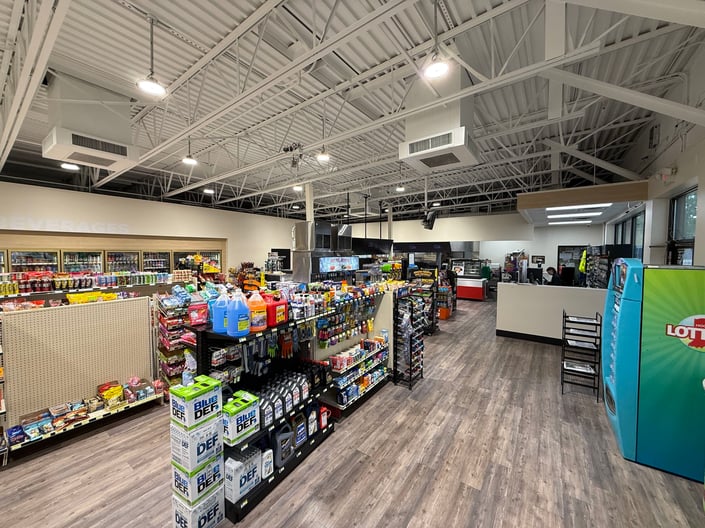
To run permits and inspections across a multi-site remodel, treat each jurisdiction as its own clock, prove the inspection sequence on one pilot site, and copy forward only what passed. Facilities management (FM) teams feel a remodel wave as a calendar. The store feels it as customer experience: a dark front door, a closed restroom, or a kitchen that cannot serve. Brand standards can match from city to city. Permits, reviewers, and inspection order are local.
|
Key takeaways
|
Why does the first site set the inspection path?
Model codes from the International Code Council give teams a shared language. Each city or county still applies them through its own permit office, often called the authority having jurisdiction (AHJ). Electrical, plumbing, health, fire, and sign inspections rarely share one appointment. When the pilot site learns the right order, every later site can borrow that lesson instead of rediscovering it. Lock the path on one site, then scale it.
What are the five steps to run permits and inspections across multiple sites?
| 1 | Map each jurisdiction Capture the submitted packet, the expected review days, and who pulls the permit. Suggested owner: local jurisdiction lead. |
| 2 | Prove the order on a pilot site Confirm the sequence for electrical, plumbing, health, fire, and sign inspections. Suggested owner: trade leads. |
| 3 | Decide stay open or go dark Set the sales and customer experience plan for noise, access, and what still has to sell during construction. Suggested owner: facilities and operations. |
| 4 | Close out with proof Gather inspection sign-off and photos, and give the punch list an owner before the next site copies scope. Suggested owner: project lead. |
| 5 | Scale the wave Reuse the proven order, adjust it for each local office, and keep a normal work-order path open for urgent repairs. |
What stays the same and what changes by jurisdiction?
|
Travels from site to site ● Brand standard and finishes ● Scope drawings and hold points ● Closeout photo set ● Punch list format ● Work-order path for urgent repairs |
Set locally ● Permit application and reviewer ● Review days ● Inspection booking and order ● Which inspections apply (health, fire, sign) ● Who is allowed to pull the permit |
Permit rules vary by city and county. Confirm each jurisdiction before you publish a national calendar.
Where do multi-site remodels lose calendar days?
Every portfolio loses time in a slightly different place. Start a delay log on the pilot site and let it guide staffing for the rest of the wave. Three areas are worth watching from day one:
|
Permit review time Review clocks differ by city and county, so one national date rarely holds. |
Re-inspections A missed hold point or an incomplete closeout can mean waiting for another inspection slot. |
Trade sequencing Electrical, plumbing, and sign work each have their own windows, and overlap creates waiting. |
|
A remodel that keeps the front door working is a customer experience project. Permits and inspections are how you own that outcome in every city on the list. |
How do service providers stay in the sequence?
Licensed service providers (SPs) do their best work when they have the inspection window, site access, and a scope that matches their trade. A national bench of 150K+ technicians helps most when the local license and the inspection slot line up. Plan separate trade crews for electrical, hood, and sign-off rather than asking one crew to cover all three. Urgent repairs that keep the store selling during construction still follow the normal work-order path, with a one-day quote target, so a failed cooler does not wait on the remodel calendar.
Before each trade arrives, share this checklist:
| ☐ | Inspection window |
| ☐ | Site access |
| ☐ | Scope matched to the trade |
| ☐ | Drawing set and hold points |
| ☐ | Who calls the inspector |
| See store refresh and remodel programs |
Frequently Asked Questions
Can one permit cover a multi-state rollout?
Plan on a permit path per jurisdiction. Brand standards can be identical, while the application, reviewer, and inspection order are local. Build the national calendar from those local clocks.
Which inspections usually sit on the critical path?
Electrical, plumbing, health, fire, and sign or facade work can each hold the next trade. List them in the order the pilot site actually passed, then reuse that order.
Should the store stay open during a remodel?
Decide stay-open or dark before construction starts, with a customer experience plan for noise, access, and what still has to sell. A dark week and a stay-open week need different inspection timing.
What closes a site so the next one can start?
Passed inspections, photo closeout, and a punch list with an owner. If scope is still open on one site, close it out or flag it before it is copied forward as standard.
The 150K+ technician figure is a Vixxo program proof point. Local permit offices control the actual application.
Sources: Store refresh and remodels; Retail remodels without revenue disruption; International Code Council model codes.