

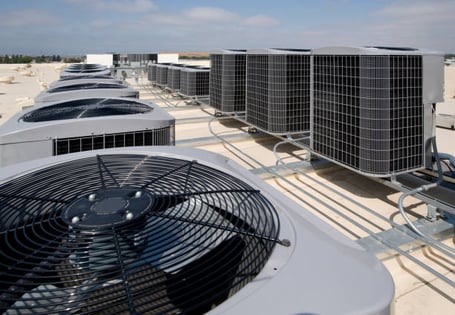
Every summer, the same pattern plays out across convenience stores, grocery locations, restaurants, and retail sites from coast to coast. A Heating, Ventilation, and Air Conditioning (HVAC) unit that was quietly struggling through spring finally hits its limit under a string of 95-degree days. A priority-one (P1) work order (WO) gets dispatched. An overtime technician arrives. Parts are expedited. The invoice arrives and it is painful.
The facilities directors who avoid this scenario are not lucky. They are running a proactive preventive maintenance (PM) program that was locked in before Memorial Day. The ones who are not are simply funding the most expensive version of HVAC management available: reactive emergency repair at summer overtime rates.
What Reactive HVAC Management Actually Costs
$1,632
Average P1 emergency HVAC repair cost due to overtime labor and expediting fees1
3–9x
More expensive: unplanned reactive repairs vs. scheduled PM visits2
$5,570
Avoidable HVAC spend identified at a single retail location over one summer season1
Why Summer Is HVAC's Breaking Point
Commercial rooftop units (RTUs), split systems, and variable refrigerant flow (VRF) systems are all engineered to operate within a defined load range. Summer breaks that range. When ambient temperatures climb past 90°F or 100°F, your system is working exponentially harder to maintain interior comfort targets. Compressors run longer. Refrigerant circuits are under sustained pressure. Filters that were marginal in April become a chokepoint in July.
Add increased store foot traffic, doors opening constantly, and the ambient heat load from food service equipment running at full capacity, and you have a formula for failure. The units that make it through are not necessarily newer or better. They are the ones that went into summer with clean coils, checked refrigerant charge, functioning belts and motors, and clear drain lines.
The ones that do not make it generate some of the most expensive work orders of the year — and they always seem to fail on the hottest weekend of the summer.
P1 emergency calls spike in July and August.
That is when technician availability is tightest and overtime premiums are highest.
The Real Cost of One Bad Summer at One Location
Vixxo analysis of HVAC work order data at a single retail location across one summer season revealed a pattern that repeats across multi-site portfolios everywhere. Over a 63-day stretch from July through September, the location logged six HVAC failures coded as "too high" or "warm/hot," two same-day follow-up calls, and four possible recall events. Total spend: $6,350 plus a fall PM. Of that, $5,570 was identified as potentially avoidable with a properly structured pre-summer PM program.1
That is one location. Multiply that pattern across a portfolio of 50, 200, or 1,000 sites and the avoidable spend becomes a material budget line that shows up as unexplained HVAC cost growth quarter after quarter.
Single Location — HVAC Summer Spend (July–September)
| Date | Problem Code | Priority | Cost | Flag |
|---|---|---|---|---|
| Jul 4, 2024 | Too High | P1 | $780.00 | Holiday OT |
| Jul 4, 2024 | Too High | P3 | $1,125.00 | Addt'l Work? |
| Jul 24, 2024 | Warm/Hot | P3 | $1,769.27 | Recall |
| Aug 25, 2024 | Warm/Hot | P3 | $1,205.75 | Recall |
| Sep 3, 2024 | Too High | P1 | $825.00 | Onsite Work Found |
| Sep 5, 2024 | Warm/Hot | P1 | $645.00 | Recall |
| Total — 63 days, one location, one summer | $6,350.02 | $5,570 avoidable | ||
Source: Vixxo multi-site retail operator HVAC work order analysis. Location data anonymized.1
The PM Proof: What Happens When You Actually Do It
Vixxo's PM impact case study data across multi-site operators makes the return on investment (ROI) case in concrete terms. In year one of a structured PM program, repair volumes were 60% lower than observed baselines. Energy costs fell by 16.7% at PM locations relative to a control group where no PMs were completed. High-quality repairs also generated a 5 to 10% reduction in work order volume in the months following each maintenance visit.3
When the PM program was cancelled to reduce costs, energy spend at those locations reverted to the pre-PM baseline within two quarters. The savings evaporated almost immediately.
After three years, repair volumes at consistently maintained locations were 35 to 40% lower than at locations where PM was absent. The compounding benefit of a PM program is not theoretical. It is measurable, and it grows over time.3
PM Program Impact — Vixxo Multi-Site Case Study3
60%
Lower repair volumes in Year 1 vs. baseline
16.7%
Energy cost reduction vs. control group in Year 1
35–40%
Lower repair volumes at Year 3 vs. non-PM locations
Your Pre-Summer HVAC PM Checklist
A pre-summer HVAC PM sweep should cover every unit across every location before sustained heat arrives. For RTUs, split systems, and VRF systems, the core checklist includes:
✓ Coil Cleaning
Dirty condenser and evaporator coils are the single most common cause of reduced HVAC efficiency. Clean coils before summer heat makes the problem a crisis.
✓ Refrigerant Check
Low refrigerant charge in summer means your system cannot maintain setpoints under load. Verify charge levels and inspect for leaks at every unit.
✓ Filter Replacement
Clogged filters restrict airflow and force systems to work harder. Replace before summer, not during. A choked filter in July is an emergency repair waiting to happen.
✓ Drain Line and Pan Flush
Condensate drain lines clog fastest in high-humidity summer conditions. Flush and treat drain pans before the season to prevent water damage and mold.
✓ Belt and Motor Inspection
Worn belts and degraded fan motors fail under sustained summer load. Inspect and replace marginal components before they become a P1 event on the busiest weekend of July.
✓ Controls and Thermostat Calibration
A miscalibrated thermostat means your system either overcools and wastes energy or undercools and fails your customers. Verify controls accuracy at every unit before summer load hits.
The Recall Problem: When PM Is Done Wrong
One of the most revealing data points in Vixxo's HVAC analysis is the recall rate following PM visits. Across one major multi-site operator's portfolio, 10% of HVAC repair calls that incurred cost occurred within 14 days of the last mechanical PM. Another 17% occurred within 30 days.1
This is not a PM scheduling problem. It is a PM quality and accountability problem. When a maintenance visit does not include proper diagnostics, documentation, and follow-through on identified issues, it creates a false sense of readiness heading into peak season. The PM box gets checked. The underlying problem goes unresolved. And three weeks later, another work order goes in at P1 rates. Quality PM matters as much as scheduled PM.
Because a hot store or a broken coffee machine is not just a maintenance issue. It is a customer experience failure. So we specialize in the hard stuff.
Vixxo Facility Solutions
Vixxo HVAC and Facilities Scale
150K+
Skilled Service Providers
200K+
PM Services Completed
3M+
Managed Assets
99%+
Equipment Uptime
12–18%
Operational Cost Savings
from HVAC PM4
Don't let July write your HVAC budget.
Vixxo builds pre-summer HVAC PM programs across multi-site convenience, grocery, restaurant, and retail portfolios — with the network depth and asset-level data to execute at scale before peak heat arrives.
Talk to a Vixxo HVAC Expert →Frequently Asked Questions
When should pre-summer HVAC PM be completed for commercial locations?
Pre-summer HVAC PM should be completed at least 6 to 8 weeks before your region's peak heat season. For Sun Belt markets, that means April at the latest. For northern climates, early May is the target. Waiting until June means competing for technician availability at the same time as every other operator — and arriving too late to address deficiencies before the first heat wave. RTU (rooftop unit) PM in particular requires adequate lead time for coil cleaning, refrigerant verification, and any parts replacement identified during the inspection.
Why do HVAC repair costs spike in summer compared to other seasons?
Summer P1 HVAC emergencies carry overtime labor premiums, expedited parts fees, and travel surcharges that inflate the cost of an otherwise standard repair significantly. A repair that runs $739 at standard P5 priority can cost $1,632 or more at P1 emergency rates due to overtime authorization. Technician availability is also tightest during peak summer months, meaning response times extend precisely when the customer experience impact of a hot store is highest. Unplanned reactive maintenance typically costs 3 to 9 times more than the same work performed on a scheduled PM basis.
What does HVAC PM actually deliver in measurable savings?
Vixxo PM case study data across multi-site operators shows repair volumes 60% lower than baseline in Year 1 of a structured PM program, energy costs down 16.7% versus a control group, and repair volumes 35 to 40% lower at Year 3 compared to non-PM locations. Routine HVAC servicing can also save 12 to 18% in operational costs through improved energy efficiency. When PM programs are cancelled, these gains reverse within two quarters — confirming that the savings are directly tied to ongoing maintenance consistency, not a one-time fix.
How does Vixxo execute HVAC PM programs across large multi-site portfolios?
Vixxo coordinates pre-summer HVAC PM sweeps across multi-site portfolios through a network of more than 150,000 skilled service providers, with specialized teams covering RTUs, ground-mounted units, split systems, VRF (variable refrigerant flow) systems, and large dehumidifiers. Asset-level tracking ensures PM completion is documented at the individual unit level, not just location level, so facilities directors have verifiable compliance data rather than provider self-reporting. Smartsheet dashboards and real-time work order visibility through VixxoLink give VPs of Facilities a portfolio-wide view of PM status heading into peak summer season.
Citations
1 Vixxo internal HVAC work order analysis, multi-site retail operator assessment. Location data anonymized. vixxo.com
2 GoFMX. “Benefits of Preventive Maintenance.” gofmx.com
3 Vixxo PM Impact Case Study: M&R and Energy, multi-site operator longitudinal data. vixxo.com
4 Design Comfort Co. “Studies Show HVAC Maintenance Pays for Itself.” designcomfortco.com | Analytika | Brightly Software
© 2026 Vixxo Facility Solutions. All rights reserved. | vixxo.com
Want to talk facilities?
Leave a comment or question below and we'll reach out!