

Coffee continues to outperform across foodservice and retail-adjacent environments, and the most important signal for facilities leaders is not just growth. It is where that growth is showing up.
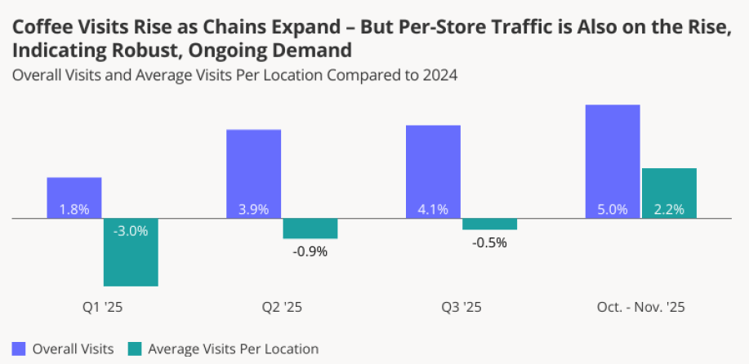
According to Placer.ai’s December 2025 coffee report, overall visits to coffee chains grew steadily throughout 2025, reaching 5.0% year-over-year growth by October–November, while average visits per location turned positive at 2.2% during the same period. Expansion did not dilute demand. Traffic intensified at the store level.
Source: Placer.ai, 6 Coffee-Inspired Strategies That Can Reshape Dining in 2026, December 2025
For facilities directors and VPs, this matters because per-store traffic growth fundamentally changes risk, cost exposure, and performance expectations.
Higher Traffic Density Leaves No Margin for Downtime
When traffic grows without dilution, every asset inside the four walls works harder for longer periods of time. Coffee machines, grinders, hot water systems, electrical panels, plumbing, refrigeration, and HVAC are all operating closer to their limits, especially during morning peak hours.
In this environment, even brief outages have outsized impact. A coffee station down for 30 minutes during a high-volume morning rush does not just delay service. It drives abandoned transactions, longer lines, labor inefficiencies, and brand damage that compounds across locations.
Facilities performance shifts from a cost center conversation to a revenue protection mandate.
Peak Demand Exposes Weak Maintenance Models
The Placer.ai data shows that coffee demand remained resilient even as consumers pulled back in other discretionary categories. That resilience creates operational pressure. Reactive maintenance models that rely on dispatching after failure struggle under sustained peak loads.
Common failure points during high-traffic coffee periods include inconsistent water temperature, electrical capacity issues, clogged drains, grinder calibration problems, and delayed service response times. These issues are rarely catastrophic on their own, but under high visit density they quickly cascade into customer experience failures.
Facilities leaders overseeing convenience stores, grocery, and retail locations with coffee programs are increasingly judged on uptime consistency, not just average cost per work order.
Why Per-Store Traffic Growth Changes the Economics
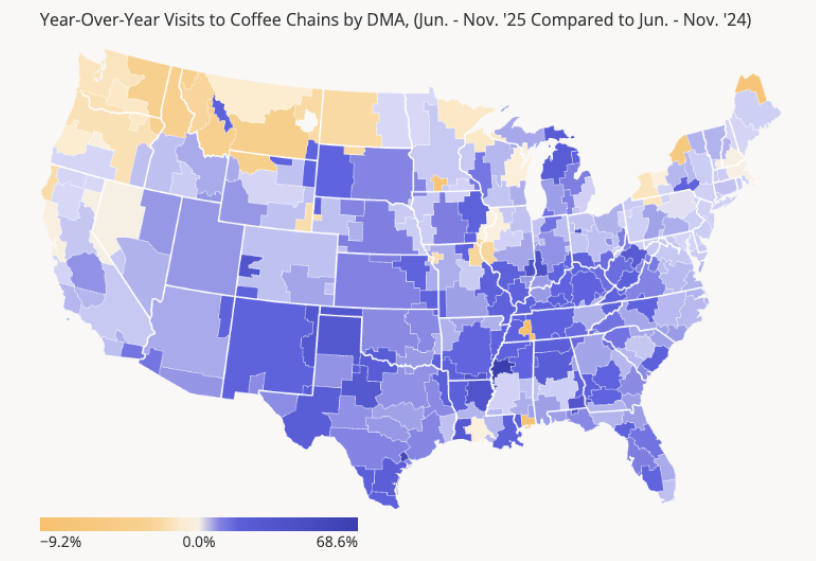
Placer.ai’s year-over-year visit heat map highlights where this traffic growth is concentrating geographically, increasing utilization and failure risk at the store level rather than spreading demand evenly across networks.
Source: Placer.ai, 6 Coffee-Inspired Strategies That Can Reshape Dining in 2026, December 2025
When average visits per location rise, the cost of downtime increases faster than maintenance budgets. A store doing higher volume cannot afford the same repair timelines, callback rates, or first-time fix gaps that may have been acceptable in lower-traffic periods.
This is where total cost of ownership becomes critical. Lower hourly rates or deferred maintenance may appear cost-effective on paper, but under sustained traffic they often lead to repeat calls, emergency dispatches, and lost sales that quietly erode margins.
Facilities teams that plan for peak utilization rather than average utilization are better positioned to stabilize costs and protect revenue.
How Facilities Leaders Can Respond
High-performing organizations treat coffee-driven traffic growth as a planning signal. They prioritize preventive maintenance on beverage equipment, align service provider coverage to peak hours, and use data to identify locations where rising volume increases failure risk.
At Vixxo, this approach focuses on maximizing asset uptime during the moments that matter most. By combining national scale, trade specialization, and real-time performance visibility, facilities teams can support higher traffic without increasing disruption or overspend.
Coffee may drive traffic, but facilities performance determines whether that traffic converts.
FAQs
Why does per-store traffic matter more than total visit growth for facilities teams?
Because higher traffic density increases asset utilization and raises the cost of downtime, making failures more disruptive and expensive.
Which facility systems are most impacted by rising coffee traffic?
Coffee and beverage equipment, electrical systems, plumbing, refrigeration, and HVAC experience the highest strain during peak demand periods.
How can facilities teams prepare for predictable coffee demand spikes?
By shifting from reactive maintenance to preventive strategies, aligning service coverage to peak hours, and managing assets based on total cost of ownership rather than hourly rates.
Want to talk facilities?
Leave a comment or question below and we'll reach out!