

.png?width=615&height=346&name=Article%20Images%20(3).png)
Not-to-exceed limits (NTEs) were designed to control facilities spend. On paper, they do exactly that. They cap invoice exposure and reduce approval risk on individual work orders.
In practice, however, lower NTEs often increase Total Cost of Ownership (TCO) by introducing delays, repeat visits, and soft costs that never appear on an invoice.
The problem is not NTEs themselves. The problem is mistaking price control for cost control.
Why Lower NTEs Rarely Deliver Lower Spend
Under traditional NTE models, cost control often introduces additional steps that extend downtime and increase total cost.
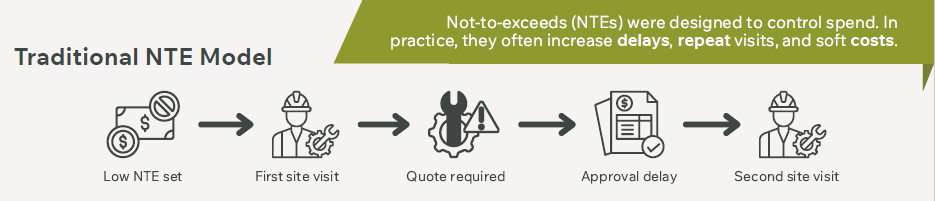
Work that exceeds a preset dollar threshold triggers a familiar sequence: the technician visits the site, identifies additional scope, submits a quote, waits for approval, and returns for a second visit. Each step adds time, labor, and disruption to operations.
While the invoice may stay within the NTE, the total cost quietly rises. Quoted work routinely takes longer than non-quoted work, extending downtime and increasing labor inefficiency. Multiple truck rolls drive repeat travel costs, while unresolved issues increase the likelihood of callbacks and duplicate work orders.
None of these costs are captured by a lower NTE. All of them compound TCO.
The Hidden Costs NTEs Don’t Manage
NTEs are effective at managing financial risk per work order. They are ineffective at managing the operational realities that drive long-term cost.
Those realities include:
- Asset downtime that disrupts revenue-generating operations
- Approval delays that extend outages
- Repeat visits caused by fragmented scopes of work
- Labor inefficiencies created by second and third truck rolls
- Soft costs absorbed by store teams and field operations
True cost includes everything that happens between work orders, not just what shows up on the invoice. When facilities teams focus too narrowly on NTE thresholds, they often trade visible savings for invisible losses.
How NTEs Distort Facilities Decision-Making
Lowering NTEs can also change behavior in unintended ways. Technicians may stop work early to avoid exceeding limits. Necessary repairs get deferred into future calls. Non-priority issues remain unresolved until they escalate into emergencies.
The result is a higher volume of work orders, more reactive maintenance, and rising total spend over time. Facilities leaders may feel in control because individual invoices look smaller, even as overall costs trend upward.
This is a classic TCO trap. Price discipline without execution discipline rarely produces sustainable savings.
Shifting From NTEs to Outcome-Based Cost Control
Effective facilities programs treat NTEs as a guardrail, not a strategy. Cost control improves when organizations focus on completing work in a single visit, reducing approvals, and preventing repeat calls before they occur. At Vixxo, this means applying real-time expertise to NTE reviews, allowing routine work to flow without unnecessary friction, bundling non-priority tasks by trade, and prioritizing emergencies to avoid prolonged downtime.
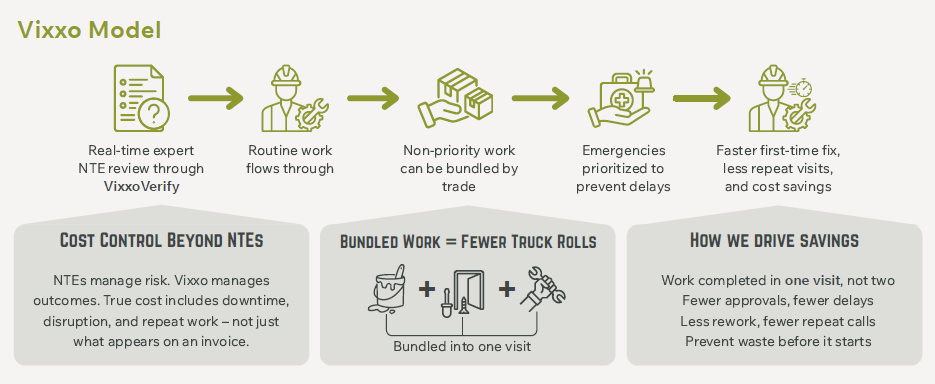
The goal is not simply to stay under an NTE, but to eliminate the conditions that inflate TCO in the first place.
When work is completed in one visit instead of two, approvals are minimized, and repeat calls are reduced, facilities teams control cost at the system level, not just the invoice level.
NTEs Manage Risk. TCO Measures Reality.
NTEs will always play a role in facilities management. They help manage risk and create financial boundaries. But they are only one input into a much larger cost equation.
Facilities leaders who want sustainable savings must look beyond price caps and manage outcomes instead. Total Cost of Ownership is shaped by uptime, execution speed, and repair quality, not just the number printed at the bottom of an invoice.
Lower NTEs may control price. Managing execution is what controls total cost.
FAQs
What is the biggest limitation of NTEs in facilities management?
NTEs cap invoice amounts but do not account for downtime, delays, repeat visits, or other soft costs that increase TCO.
Do lower NTEs always increase total cost?
Not always, but when paired with approval delays and fragmented work execution, lower NTEs often drive higher long-term costs.
How can facilities teams improve cost control beyond NTEs?
By focusing on first-time fix rates, bundling work, reducing approvals, and managing assets based on total cost of ownership rather than invoice price alone.
Want to talk facilities?
Leave a comment or question below and we'll reach out!