

Facilities Management News


How AI Gave a Retail Facility Team Its Day Back

By Vixxo Management | Nov 10, 2026, 5:59:59 AM | 8 minute read


Inside Vixxo · AI in operations

How AI Gave a Retail Facility Team Its Day Back

Inside the automation Vixxo Facility Solutions built for a national retailer program with thousands of locations.


Key takeaways

  • A national retailer program with thousands of locations was generating survey data, site folders and quote packages by hand, one location at a time.
  • Vixxo connected the tools the team already used so that survey answers fill the tracker, build the site folder and produce the quote package automatically.
  • The team member who builds these packages said each one used to take about 45 minutes to an hour. After the automation, the repetitive assembly is done by AI before they manually open the folder.

The situation: a big new program with high expectations

When a major national retailer brought thousands of locations to Vixxo, the whole organization was excited. The program was also demanding, and the team supporting it was feeling the pressure.

The program did not yet have a system built around it. Field surveys for equipment such as air conditioners and coolers were coming back through a form tool, and all of that information had to be logged in a project tracker before a job could move forward. Then came the quotes, and the customer was starting to feel the wait.

What the work looked like before, and after

For each location, a team member used to handle every step by hand. None of these steps required expert judgment, but all of them took time, and they repeated for every site.

Before: by hand, every site

  • Copy survey answers into the project tracker.
  • Create a folder for the site, with matching subfolders.
  • File the survey in the right place.
  • Add a link from the tracker row back to the folder.
  • Build the quote package for the client.

After: assembled automatically

  • Survey answers fill the tracker row.
  • The site folder and subfolders are created.
  • The survey is filed automatically.
  • The tracker row links straight to the folder.
  • Quote sheets are generated and waiting in the folder.

What VIXXO built

The automation works in two stages, followed by a person.

Stage one

Intake

→

Stage two

Quote package

→

Final gate

Human review

Stage one: intake. When a survey comes back, the system fills the project tracker row automatically. At the same time it creates the site’s folder in SharePoint with the right subfolders, files the survey in the surveys folder, and adds a link from the tracker row to that folder. One click takes a team member from the tracker to everything about the site.

Stage two: the quote package. A second tool reads the tracker and generates four sheets, including a tax sheet and a quick-reference sheet of the survey notes. They land in the site folder, ready to open.

From there, the team member opens the folder, checks the sheets and sends them. Vixxo is now adding a third piece: collecting purchase order numbers from emails and attaching the number and a link to the right tracker row, so nobody has to do that by hand either.

The human check is on purpose

The package could be pushed into the client’s portal automatically. Vixxo chose not to.

“Before anything reaches the client’s portal, we review it carefully and make sure it’s right.”

- Peter Cardinal, Director, Design & Integrations at Vixxo Facility Solutions

A person reviews every package before the client sees it. The automation removes the assembly work. It does not remove the judgment.

The result: time back in the day

45–60 min

per package, the old way

The team member who builds these packages told Peter that each one used to take about 45 minutes to an hour. Now the assembly is finished when she opens the folder.

Lessons for operations teams

Start with steps that need no judgment Data entry, folder creation, filing and linking are good candidates. Quote review and client delivery are not.
Keep a person at the final gate Automation can assemble the package. A person decides whether it is right to send.
Expect to connect several tools The value comes from linking the systems your team already uses, and that takes patience.
Share what works Vixxo’s projects group runs a small internal AI council that meets monthly. Each member keeps a project of their own. When someone gets stuck, the group points them to a teammate who has solved a similar problem and hands over a working start instead of a long explanation.

Frequently asked questions

Does this replace the people who build quote packages?

No. It removes the repetitive assembly so they can spend their time checking the work and talking with the client.

Why not automate delivery to the client portal?

Vixxo wants a person to confirm each package is accurate before the client sees it.

Do you need to be a developer to build this?

Peter does not write code. He builds with an AI coding assistant and focuses on the process the team follows.

What happens with the survey data?

It fills the project tracker automatically, and the original survey is filed in a matching site folder with a link back to the tracker row.

Conclusion

For a program with thousands of locations, small manual steps add up to days of work and a customer who feels the delay. Automating the repetitive steps and keeping a person at the final review gave one team its time back without giving up accuracy.

Spend less. Stress less. One work order at a time.
Topics: Facilities Management Artificial Intelligence

How Vixxo’s AI Assistant Helps Facilities Teams Close the Knowledge Gap in the Field

By Vixxo Management | Nov 5, 2026, 5:00:00 AM | 9 minute read


AI in Facilities | Field Operations

For facilities leaders, the hardest work orders are rarely hard because someone forgot to open a request. They are hard because the equipment is critical, the location cannot wait, and the first person on site needs enough context to make the right next move.

By Vixxo Facility Solutions

Faster context

Technicians spend less time hunting for practical repair information.

Better questions

Support teams can guide the next step with clearer asset and issue context.

Human control

People still diagnose, repair, verify, and decide.

That is where AI can create real value in facilities management. Not as a replacement for technicians. Not as a black box making repair decisions. But as a faster way to put useful knowledge in the hands of the people doing the work.

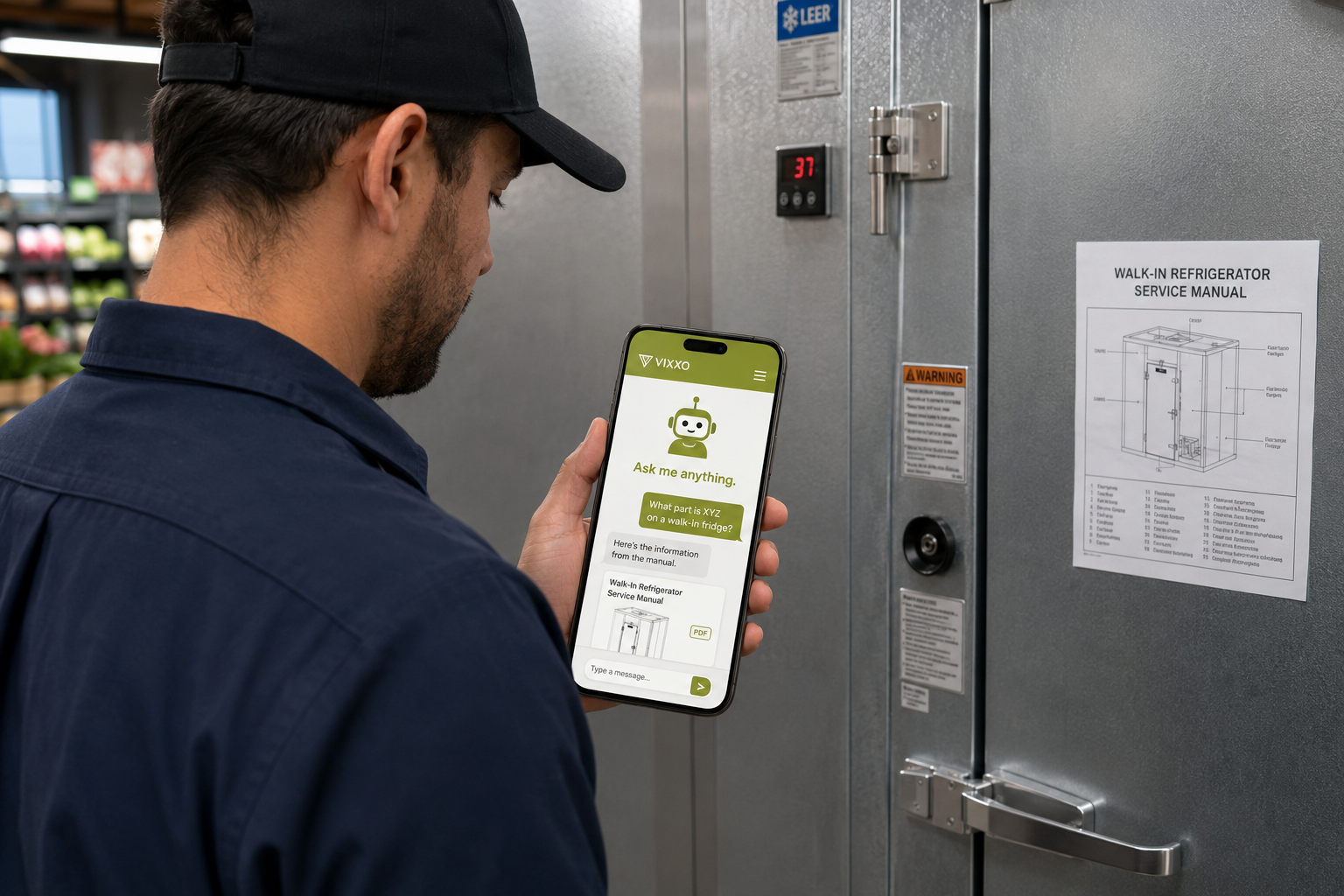
Vixxo’s AI assistant points to a practical use case: helping field technicians and support teams get to better answers faster when they are dealing with critical maintenance and repairs. In multi-site facilities, every minute spent hunting for equipment history, troubleshooting steps, or scope guidance can slow the outcome. AI helps close that gap.

Why the Knowledge Gap Matters

A technician may know the trade. A customer may know the location. Vixxo may know the asset, service history, common failure patterns, and customer expectations. The opportunity is bringing that context together at the moment it matters.

That is especially important for revenue-generating equipment and customer-facing repairs. A down coffee machine, failed refrigeration case, fuel equipment issue, or broken front-of-house asset is not just an operational problem. It can become a customer experience problem quickly.

The practical AI test:

Does it help the team get to the right next step faster while keeping accountability with the people responsible for the outcome?

What Changes When AI Supports the Field

AI helps by making institutional knowledge easier to use. Instead of forcing teams to search across old notes, manuals, prior work orders, and tribal knowledge, an assistant can help surface the right questions, likely causes, safety considerations, and next steps.

Field moment Common friction How Vixxo’s AI assistant helps
Before diagnosis Technician starts with limited issue history. Surfaces relevant asset, symptom, and prior-work context faster.
During troubleshooting Manuals, notes, and known issue patterns may be scattered. Helps organize likely next questions and repair considerations.
Before escalation Teams may not know what has already been checked. Creates a clearer path for support teams to understand status and guide next steps.
After the visit Learning from one site may not carry to the next. Makes repeat patterns easier to recognize across locations and equipment types.

The technician still owns the diagnosis. The service provider still performs the work. The human team still makes the call.

The difference is speed to useful context.

Why Multi-Site Operators Should Care

For facilities leaders, this matters because the industry is under pressure from every side. Equipment is more complex. Experienced labor is harder to find. Multi-site operators need consistent outcomes across very different markets.

A great technician in one region may know a pattern that another technician has not seen before. AI can help make that knowledge more portable.

Service

More consistent support for critical maintenance and repairs that shape customer experience.

Speed

Faster access to repair context when downtime is already affecting the site.

Scale

Shared knowledge can travel across locations, trades, and service provider teams.

AI Should Strengthen Accountability, Not Remove It

The best AI use cases in facilities management do not remove accountability. They strengthen it. They help teams ask better questions earlier, reduce avoidable delay, and make clearer decisions before downtime turns into lost revenue or customer frustration.

That is the practical promise of AI in the field: not replacing expertise, but extending it.

When AI helps a technician understand the asset faster, review likely causes, and prepare for the next step, the work order moves with more confidence. When support teams can see patterns across locations, they can help resolve issues before they become chronic. When customers get clearer updates, they gain trust that the issue is being handled like it matters.

Critical equipment handled like it’s our own.

Vixxo owns the outcome on critical maintenance and repairs that matter most to customer experience. AI is one more way to help teams do that with more speed, consistency, and confidence.

Frequently Asked Questions

Does AI replace field technicians?

No. AI supports technicians with faster access to relevant information. People still diagnose, repair, verify, and make decisions.

Where does this help most?

It is most useful on critical equipment, repeat issues, complex assets, and customer-facing repairs where faster context can improve the outcome.

Why does this matter for multi-site operators?

Multi-site facilities teams need consistent decisions across many locations, trades, and service providers. AI can help make proven knowledge easier to reuse.

What should facilities leaders look for in AI?

Look for AI that improves speed and decision quality while preserving human accountability. The goal is better outcomes, not automation theater.

Topics: Facilities Management Artificial Intelligence

Your CMMS Shows the Problem. AI Invoice Auditing Cuts the Bill

By Vixxo Management | Nov 3, 2026, 7:00:01 AM | 10 minute read

How AI invoice auditing closes the gap between facilities visibility and facilities cost control for multi-site operators.

Key takeaways

✓ A CMMS tells you what work was ordered. It does not check whether the invoice for that work was fair.
✓ Lower hourly rates can hide longer labor durations, materials markups and repeat dispatches.
✓ Retail and convenience portfolios commonly overspend 10% to 15% because of limited oversight, duplicate work orders and inconsistent service quality.
✓ Automated, real-time invoice auditing catches overcharges before they reach the ledger. Vixxo reports 19% to 24% lower facilities overspend for operators using automated invoice auditing and outcome-based service contracts.

The problem: you can see everything and still overspend

If you run hundreds or thousands of locations, you probably already have a computerized maintenance management system (CMMS). It logs work orders, tracks status and shows you which sites generate the most tickets. That is real visibility, and it is worth having.

But visibility is not control. A CMMS records that a technician was dispatched and that an invoice arrived. It does not, on its own, ask the harder questions:

?
Did the technician actually spend the hours billed?
?
Is the parts price in line with the market in that region?
?
Was this the second visit for the same fault?
?
Is this a duplicate of a ticket opened last week?

Without a structured process to answer those questions, the gap between what you can see and what you can control shows up as value leakage. Across a portfolio of thousands of locations, small overcharges accumulate into a seven-figure problem.

Where the money leaks

Four patterns account for most hidden spend in multi-site facilities programs.

Leak What it looks like Why a CMMS alone misses it
Labor expansion Hours billed exceed what the job normally takes The system stores the invoice, not a benchmark for the job
Materials markups Parts priced well above regional market rates No pricing database sits behind the work order
Callbacks and repeat dispatches The same issue is fixed more than once Repeat calls are logged as separate tickets
Duplicate work orders Two tickets for one problem Duplicates look like normal volume

A fifth pattern sits underneath all four: outlier sites. A handful of stores often drive a disproportionate share of spend, and without location-level analysis they stay hidden inside portfolio averages.

Why the lowest hourly rate is the wrong target

Many procurement teams negotiate on hourly labor rate because it is easy to compare. It is also an incomplete picture. A low rate can still add up to a larger bill through longer durations, materials markups and repeat visits.

Total cost of ownership is the more useful measure.

13.2%

lower total invoice

In one example Vixxo cites, a provider focused on total cost delivered a 13.2% lower total invoice despite charging a higher hourly rate. The rate looked worse on paper. The invoice told a different story.

What AI invoice auditing does differently

AI invoice auditing moves the check from after the bill is paid to before it is approved. Instead of sampling invoices or reviewing them by hand, it evaluates every line item automatically. A strong audit system does four things:

1
 

Benchmarks against history

It compares labor, parts and travel charges against decades of cost data and regional standards.

2
 

Validates the work itself

It checks geo-fenced time on site, local tax compliance and photo evidence that the job was completed.

3
 

Flags anomalies in real time

It catches labor rounding, parts markups, travel fees and duplicates while the work order is still in progress, not weeks later.

4

Escalates to a human

When a price deviates from the market-rate alternative, the invoice goes to a trade expert for detailed review.

The last point matters. The goal is not to replace judgment. It is to point scarce expert attention at the invoices that need it, as a shared second set of eyes for everyone involved in the work.

How Vixxo approaches it

Vixxo built this model into VixxoLink, its facilities management platform, through two connected systems:

VixxoVerify

Patented invoice validation

Reviews every invoice line item against more than 40 years of cost data and real-time benchmarks, and verifies job completion with photo evidence before the client receives a bill.

CAPS

Continuously Analyzed Pricing System

Audits provider invoices in real time to address overages such as labor rounding, part markups and travel fees. It draws on more than 45 million industry- and region-specific data points.

14%

average excess materials cost found on invoices without oversight

$2.6M

direct cost savings for convenience and grocery clients in the 12 months ending August 31, 2026

What to look for in your own program

Whether you build, buy or partner, use this checklist to test whether your current setup controls cost or only reports it.

  • Does every invoice line item get checked against a benchmark, or only a sample?
  • Is the check done before approval or after payment?
  • Can you see spend and repeat-call rates by individual location?
  • Do you track provider performance, not just provider price?
  • Can you verify time on site and job completion independently of the provider’s own records?
  • Is there a human escalation path for flagged invoices?

If you answered no to more than two, your CMMS is giving you visibility without control.

Frequently asked questions

Does AI invoice auditing replace my CMMS?

No. The CMMS remains the system of record for work orders and assets. Auditing adds a cost-validation layer on top of it.

How much can a multi-site operator realistically save?

Vixxo publishes that operators using automated invoice auditing and outcome-based contracts reduce facilities overspend by 19% to 24%. Results depend on portfolio size, current oversight and provider mix.

What types of overcharges does automated auditing catch?

Labor rounding, extended durations, parts markups, travel fees, duplicate invoices and repeat dispatches for the same fault.

Is this only useful for very large portfolios?

Leakage compounds with scale, so the largest portfolios see the largest dollar impact. Any operator without location-level visibility into facilities spend can benefit.

Conclusion

Visibility is the starting point. Control comes from structured invoice audit, provider accountability and performance governance applied to every work order. For operators with nationwide locations, that combination is what turns a dashboard full of problems into a lower bill.

See how VixxoVerify puts a second set of eyes on every invoice.

Spend less. Stress less. One work order at a time.

Learn more about Vixxo
Topics: Facilities Management Artificial Intelligence

Why Multi-Site Operators Are Rethinking Sign Quotes With AI

By Vixxo Management | Oct 28, 2026, 7:30:00 AM | 10 minute read


Topics: Signs & Lighting Facilities Management Artificial Intelligence

How AI Keeps Critical Repairs Moving During a Holiday Construction Freeze

By Vixxo Management | Oct 22, 2026, 7:14:59 AM | 9 minute read


Topics: Facilities Management Artificial Intelligence

How AI Ranks Heat Calls When a Mild Winter Outlook Hides a Cold Week

By Vixxo Management | Oct 20, 2026, 10:25:56 AM | 9 minute read


Topics: Facilities Management Artificial Intelligence

How AI Completes a Work Order Before the Truck Is Assigned

By Vixxo Management | Oct 15, 2026, 7:00:00 AM | 10 minute read


Topics: Facilities Management Artificial Intelligence

AI in Facilities Management: What It Is and How Multi-Site Operators Use It

By Vixxo Management | Oct 13, 2026, 7:00:00 AM | 20 minute read


Topics: Facilities Management Artificial Intelligence

How AI Helps Facilities Teams Align Invoices With Contracted Rates

By Vixxo Management | Oct 8, 2026, 7:00:00 AM | 7 minute read


Topics: Facilities Management Artificial Intelligence

How to Prevent Repeat Facility Repairs with AI-Assisted Dispatch

By Vixxo Management | Oct 6, 2026, 9:00:00 AM | 9 minute read


Topics: Facilities Management Artificial Intelligence