

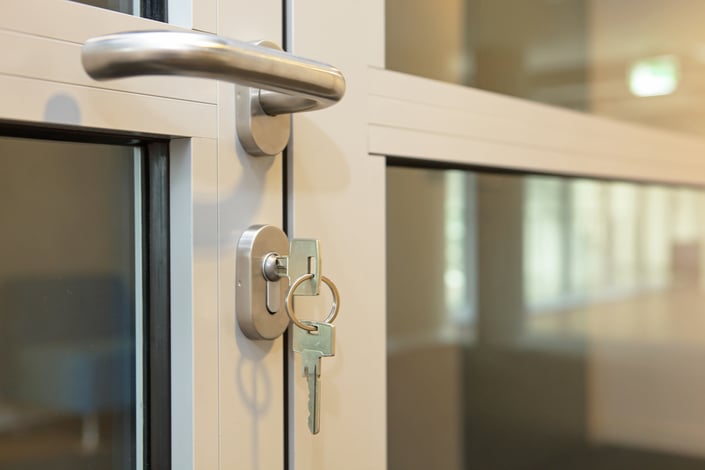
Doors, Locks & Hardware
A commercial door and lock maintenance program specifies, installs, inspects, repairs, and replaces every opening across a multi-site portfolio. For facilities management (FM) directors, missing that program is security exposure, code risk, energy waste, and unplanned capital, not a catalog gap. This is Part 1. Part 2 covers brand ecosystems, rekey cadence, and repair-versus-replace rules.
By Vixxo Facility Solutions
|
30–35% Lock calls that are hinge, closer, or alignment |
1.5–3x Emergency cost vs. a planned visit |
18–25% Spend drop in 24 months on structured PM |
Field patterns from Vixxo multi-site door and lock work. Emergency premiums vary by market and parts.
Why reactive door and lock programs fail customer experience
The opening is the first and last customer experience moment. A failed storefront closer, a panic bar that will not latch, or a back door left un-rekeyed is an unsecured store, a code risk, or lost trading hours. In a quick-service restaurant (QSR) averaging $3,000–$5,000 in daily sales, a two-hour delayed open is material. Americans with Disabilities Act (ADA) closers on interior doors must not exceed 5 pounds of opening force under ICC/ANSI A117.1. Failed storefront gasketing (ANSI/BHMA A156.22) raises HVAC load wherever it repeats.
The five lifecycle stages of a door and lock program
Every opening moves through specification, installation, planned maintenance, reactive repair, and replacement. Specify American National Standards Institute / Builders Hardware Manufacturers Association (ANSI/BHMA) Grade 2 cylindrical locks (A156.2, 400,000 cycles) on a grocery entrance and the lock hits its certified threshold in a few years. Skip a plumb-and-square check and the lockset becomes the repeat part. Forecast replacement 12–18 months out instead of paying the after-hours premium twice.
Specify BHMA Certified product, not hardware described as "designed to meet" a standard. On turnover, document plumb within 1/8 inch, reveal of 1/8 inch ± 1/16 inch, latch and deadlatch, closer speeds, exit-device latching, hinges, no daylight at the threshold, keying, fire labels, electrified fail-safe, and ADA force. On every reactive call, inspect the opening as a system before swapping the lock.
ANSI/BHMA standards that belong in the hardware spec
| Component | Governing standard | Grade 1 planning note |
|---|---|---|
| Cylindrical (bored) locks | A156.2 | 800,000 certified cycles vs. 400,000 for Grade 2 |
| Mortise locks | A156.13 | 1,000,000 cycles; 1,200 in-lbf locked-lever test |
| Exit devices / panic hardware | A156.3-2025 | 500,000 cycles; 400 lb egress-direction load |
| Door closers | A156.4 | Field-adjustable valves; leak = replace |
How traffic, not brand, should set inspection intervals
Years to a 500,000-cycle Grade 1 exit-device rating at 364 operating days.
| 100 cycles/day |
|
13.7 yr |
| 400 cycles/day |
|
3.4 yr |
| 500 cycles/day |
|
2.7 yr |
Annual cycles = daily openings × operating days. Lab certification is a planning baseline, not exact field life.
Vixxo operating recommendations (not ANSI requirements): more than 400 cycles/day or mission-critical egress gets a monthly site check and quarterly technician inspection. High traffic (150–400) gets monthly visual and semiannual technician service. Lower traffic drops to quarterly or semiannual visual and annual technician work. Fire-rated openings follow the adopted code and the authority having jurisdiction (AHJ). Grocery sliders often exceed 1,000 cycles/day. A failed walk-in gasket can raise compressor run time 15–25%. Never use petroleum lubricant on lock cylinders.
Choose Grade 1 over 150 cycles/day, and on any primary entrance, emergency exit, or security-critical door. At 300 cycles/day, Grade 2 cylindrical hardware hits its certified threshold in about 3.6 years. A Grade 1 mortise lock lasts more than 9 years on the same math. The typical 30–50% first-cost premium is cheaper over the life of a high-traffic opening.
Highest-wear points by door type
Watch the highest-wear points: storefront closer arm and continuous hinge, back-door hinge screws and strike alignment, slider belts and sensors, walk-in gaskets, dock springs, and electrified power or request-to-exit. Site staff run the visual checklist. A qualified technician does full service: adjustment, lubrication, functional test, and documentation.
| Talk with Vixxo |
Frequently Asked Questions
When should a multi-site operator choose ANSI/BHMA Grade 1 over Grade 2?
Choose Grade 1 above 150 cycles per day, and on any primary entrance, emergency exit, or security-critical door. Grade 1 cylindrical locks (A156.2) are certified to 800,000 cycles versus 400,000 for Grade 2. Grade 1 mortise locks (A156.13) are certified to 1,000,000 cycles. The typical 30–50% first-cost premium is cheaper over the life of a high-traffic opening.
How often should panic bars and exit devices be inspected?
Inspect quarterly on high-traffic grocery and retail exits, and semiannually on moderate-traffic employee exits. Test the push bar, latch, and dogging. Fire-rated exits must latch without dogging. Grade 1 devices are certified to 500,000 cycles under A156.3-2025. Flag replacement near 80% of rated cycles (about 400,000).
What percentage of door-related service calls are caused by something other than the lock?
About 30–35% across large multi-site portfolios. Common causes mislabeled as lock failure are hinge sag, a closer that will not fully shut, frame spread, and threshold heave. Inspect the opening system, not only the lockset.
How do I estimate when a lock or exit device will reach its rated cycle count?
Multiply average daily cycles by operating days per year, then divide the certified rating by that annual total. A 500,000-cycle Grade 1 exit device at 400 cycles per day and 364 days per year reaches the lab threshold in about 3.4 years. Use that math for PM and capital planning.
Are mortise locks worth the added cost over cylindrical locks for a restaurant chain?
For front-of-house and primary entrances, yes. Grade 1 mortise hardware outlasts Grade 1 cylindrical hardware and carries a higher security rating. For interior doors under 100 cycles per day, Grade 1 cylindrical locks are usually enough and cheaper to install. Decide opening by opening.
Sources: Vixxo; ANSI/BHMA A156.3-2025; A156.13-2022; ICC/ANSI A117.1. Part 2 covers ecosystems, rekey, and replace rules.