Coffee & Specialty Beverage
A national cartridge SKU is not a water program. Espresso, bean-to-cup, batch brew, and frozen beverage fail for different chemistry reasons. Facilities management (FM) directors who treat filtration as a parts swap still see morning-rush customer experience (CX) failures, because hardness, alkalinity, and chlorine are not the same problem.
By Vixxo Facility Solutions
|
150 mg/L SCA target total dissolved solids for brewing water |
>180 mg/L USGS "very hard" water, high scale risk in boilers |
40+ ppm Alkalinity floor SCA cites to limit espresso-boiler corrosion |
Sources: Specialty Coffee Association brewing water table and Water Quality Handbook; U.S. Geological Survey hardness classes.
Why does the same filter fail espresso in a hard-water market and a soft-water market?
Municipal supply is not a constant. The U.S. Geological Survey (USGS) classifies hardness as calcium carbonate: 0 to 60 mg/L is soft, 61 to 120 is moderately hard, 121 to 180 is hard, and above 180 is very hard. The Environmental Protection Agency (EPA) sets no health limit for hardness, so a legal supply can still wreck a boiler.
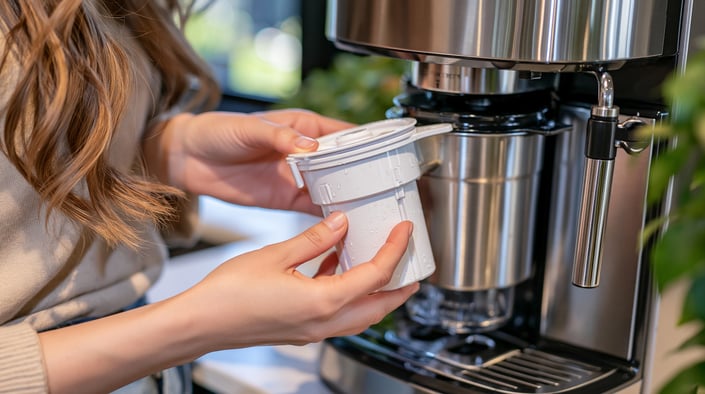
A carbon block that removes chlorine taste does little to carbonate hardness. A sodium ion-exchange softener can drop scale risk and raise sodium, which can conflict with original equipment manufacturer (OEM) specs. Reverse osmosis (RO) can drive total dissolved solids (TDS) so low the water becomes aggressive. The Specialty Coffee Association (SCA) Water Quality Handbook warns that very low alkalinity on espresso machines invites corrosion when heated water turns acidic.
One national filter spec is a false economy. Two stores can run the same machine on completely different water.
Which water measurements should facilities directors log on every beverage asset?
Log incoming and outgoing readings at the housing, not one TDS number on a clipboard. TDS is a concentration summary. It does not name the ions. SCA guidance treats hardness and alkalinity as separate controls. A 442-calibrated TDS meter also reads differently than a sodium-chloride meter. Mixed tools make the portfolio trend noise.
| Reading | What it tells you | What a bad result usually does |
|---|---|---|
| Hardness (as CaCO3) | Calcium and magnesium load | Scale on heating elements and brew valves |
| Alkalinity (as CaCO3) | Buffer against acid in hot boilers | Too high mutes the cup; too low raises corrosion risk |
| TDS (mg/L) | Overall mineral load, if the meter is calibrated | Outside 75 to 250 mg/L is a flag, not a diagnosis |
| Chlorine / chloramine | Disinfectant left in the supply | Off flavors and gasket wear; carbon media is the fix |
| Bypass position | Whether untreated water is mixing back in | A new cartridge with the bypass open is a fake pass |
How should filtration differ for espresso, batch brew, and frozen beverage?
Espresso and super-automatic boilers see the same water again and again at high temperature. They need scale control without stripping the alkalinity that protects metal. Batch brew is more forgiving on hardness and more sensitive to chlorine taste. Frozen beverage and ice often share a cold-water branch. If that branch is untreated, you get cloudy product, scale in the freeze barrel, and a coffee ticket that never names the real asset.
Illustrative scale-risk index by USGS hardness class (higher bar means higher boiler-scale risk, not a national prevalence share).
| Soft (0-60 mg/L) |
|
20 |
| Moderately hard |
|
45 |
| Hard (121-180) |
|
75 |
| Very hard (>180) |
|
100 |
Hardness classes: USGS. Scale-risk index is an editorial illustration for FM planning, not a lab measurement.
Own the outcome on the water that touches the cup, not only the machine that pours it. A heating-element failure on a high-cost espresso or bean-to-cup unit is a CX failure that started as an unread water spec.
What does a chemistry-first beverage water program look like?
Map stores to hardness bands, then assign treatment: carbon for disinfectant, hardness reduction where water is hard or very hard, and RO plus remineralization only where TDS or chlorides require it. Store incoming and outgoing readings on the filtration asset with the coffee machine. Close the bypass on every preventive maintenance (PM) visit. Do not close a low-flow work order as "machine replaced" while untreated water stays online.
Vixxo treats coffee and specialty beverage as revenue-generating equipment across 40+ trades and a 150K+ technician and service provider network. Vixxo Verify checks parts, labor, and fees on filtration and machine work so total program spend stays protected, not just the cartridge price.
| See Vixxo coffee and beverage support |
Frequently Asked Questions
What water quality does coffee equipment need?
The published SCA brewing water table targets about 150 mg/L TDS (acceptable range 75 to 250 mg/L), near-neutral pH, and no free chlorine. Espresso boilers also need enough alkalinity, often cited near 40 ppm as CaCO3, so the water does not become corrosive when heated.
Is reverse osmosis always the best water filtration for espresso machines?
No. RO is a control tool, not a default. Unremineralized RO can sit below the alkalinity floor SCA associates with boiler protection. Use it when incoming TDS, chlorides, or hardness cannot be managed with carbon and hardness reduction, then blend or remineralize to a documented spec.
Should frozen beverage and ice share the coffee water filter?
Only if the housing is sized for combined gallons and the treatment matches both uses. Shared untreated branches are a common blind spot. Map every cold-water takeoff on the beverage wall and put each housing on the same PM template as the machines it feeds.
How often should beverage water filters be changed?
Change on gallons and outgoing readings, not one national calendar. Hard-water, high-volume stores exhaust media faster. A bypass left open makes the cartridge date meaningless.
Sources: USGS hardness of water; USGS and EPA hardness FAQ; SCA Water Quality Handbook; SCA on TDS meter calibration; Vixxo coffee solutions.