

.jpg?width=511&height=287&name=Article%20Images%20(6).jpg)
Key Takeaways
- The lowest hourly labor rate rarely produces the lowest total invoice.
- Work order volume reduction drives more savings than rate negotiation.
- 20% to 30% of work orders in certain trades can be repeat or duplicate calls.
- Preventative Maintenance can reduce repair volume by 35% to 60% over time.
- 10% of locations often drive 25% or more of total portfolio spend.
- True cost control requires people, process, technology, and accountability working together.
Facilities leaders across retail, grocery, convenience, and restaurant portfolios are under pressure to control maintenance spend without sacrificing uptime. In that environment, it is tempting to negotiate the lowest hourly labor rate and declare victory.
But the real question is not:
“What is the hourly rate?”
It is:
“What is the long-term total cost of ownership?"
Rate Focus vs TCO Focus: A Simple Example
Consider two service providers:
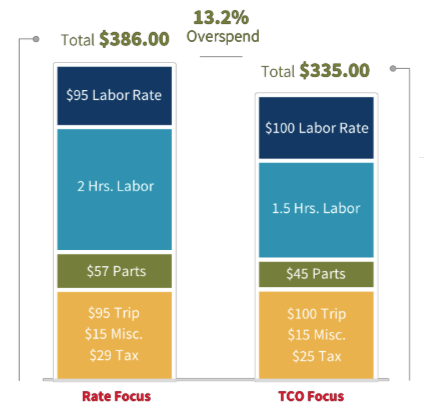
Despite the higher hourly rate, the TCO-focused provider delivered a 13.2% lower total invoice.
The takeaway is simple. Low hourly rates do not equal low total cost.
The Hidden Drivers of Overspend
Facilities spend is influenced by far more than labor rates. Across multi-site portfolios, four drivers consistently inflate cost.
1. Labor Duration Inflation
If time on site is not validated, labor hours expand. A 1.5 hour job becomes 2.0 hours. Across thousands of work orders, that variance becomes millions in excess spend.
More importantly, work order volume strongly correlates to total spend. Reducing duration and unnecessary dispatches lowers portfolio cost faster than renegotiating rates.
2. Materials and Parts Markups
In large portfolio assessments, only a small percentage of invoices include detailed material breakdowns. When line-item visibility is missing, material markup becomes difficult to audit.
Without structured invoice validation, negotiated labor savings quietly disappear through parts inflation.
3. Repeat Calls and Duplicate Work Orders
Repeat work is one of the most destructive TCO drivers. In certain trades, 28% of work orders have been identified as potential callbacks, with an additional 16% classified as duplicate or overlapping tickets.
Reducing average cost per work order is incremental.
Reducing repeat volume is transformational.
Eliminating even a fraction of unnecessary volume unlocks material savings.
4. Poor Preventative Maintenance Execution
Preventative Maintenance (PM) directly impacts reactive volume and energy cost.
Unplanned maintenance typically costs 3 to 9 times more than planned maintenance. In structured programs, repair volumes have been observed 60% lower in Year 1 after quality PM implementation, and 35% to 40% lower after three years.
Energy costs have also fallen by roughly 16% to 17% in locations where PM was consistently executed.
When PM is cut to save short-term dollars, reactive volume and energy costs rebound quickly. TCO thinking protects against that cycle.
TCO Across a Distributed Portfolio
Vixxo manages over 2.2 million assets across 220,000 locations with 150,000+ technicians and support across 75+ trades.
Scale matters. Density creates leverage. Data drives intervention.
When structured controls are applied across a national portfolio, common savings levers include:
- Callback elimination
- Duplicate work order prevention
- Labor duration validation
- Materials cost benchmarking
- PM recall controls
- Outlier site correction
Most multi-site portfolios that implement structured controls conservatively land in the 8% to 15% reactive savings range. That level of savings does not require reducing service levels. It requires improving discipline.
What Facilities Leaders Should Measure Instead
If you are evaluating your facilities program through a TCO lens, shift from rate-based KPIs to portfolio-based performance metrics:
- Average spend per work order by trade
- Work order volume per store
- Repeat call rate within 30 days
- Duplicate or overlapping ticket rate
- Time to complete by priority level
- PM recall rate within 14 to 30 days
- Outlier store concentration
In large portfolio analyses, 10% of locations have accounted for 25% or more of total spend. Targeting those outliers produces faster and more durable returns than renegotiating labor rates.
The Strategic Advantage of TCO Thinking
Total Cost of Ownership reframes facilities management from a transactional model to a strategic discipline.
Instead of asking:
“Did we negotiate a lower hourly rate?”
Facilities leaders should ask:
- Are we reducing work order volume?
- Are we eliminating repeat repairs?
- Are we extending asset life?
- Are we stabilizing energy cost?
- Are we preventing invoice leakage?
The organizations that win in today’s inflationary environment are not the ones paying the lowest hourly rate. They are the ones controlling total cost.
Facilities is no longer a reactive expense line. It is a managed asset strategy.
Every trade. Every site. Every invoice.
FAQs
What is Total Cost of Ownership in facilities management?
Total Cost of Ownership (TCO) includes all costs associated with maintaining and operating assets, including labor, travel, materials, callbacks, duplicate work orders, energy impact, and asset lifecycle performance. It evaluates full program effectiveness rather than single-line invoice items.
Why can a higher hourly rate result in lower overall cost?
Higher-skilled providers often complete work faster, reduce return visits, and use fewer materials. Reduced labor duration, fewer callbacks, and improved first-time fix rates drive lower total invoice amounts even if the hourly rate is higher.
How much overspend typically exists in multi-site facilities programs?
Based on portfolio assessments, many organizations overspend by 8% to 15% due to uncontrolled repeat calls, invoice leakage, material markups, and inconsistent preventative maintenance execution.
Is a CMMS enough to control facilities cost?
No. A Computerized Maintenance Management System (CMMS) provides visibility, but without structured invoice audit, provider accountability, and performance management, core cost drivers remain unchecked.
Want to talk facilities?
Leave a comment or question below and we'll reach out!