
Facilities Management News
Holiday Beverage Launches Are an Operations Event: What Multi-Site Operators Should Prepare For

Topics: Food Service Equipment Beverage Equipment Facilities Management
How Vixxo’s AI Assistant Helps Facilities Teams Close the Knowledge Gap in the Field
AI in Facilities | Field Operations
For facilities leaders, the hardest work orders are rarely hard because someone forgot to open a request. They are hard because the equipment is critical, the location cannot wait, and the first person on site needs enough context to make the right next move.
By Vixxo Facility Solutions
| Faster context Technicians spend less time hunting for practical repair information. |
Better questions Support teams can guide the next step with clearer asset and issue context. |
Human control People still diagnose, repair, verify, and decide. |
That is where AI can create real value in facilities management. Not as a replacement for technicians. Not as a black box making repair decisions. But as a faster way to put useful knowledge in the hands of the people doing the work.
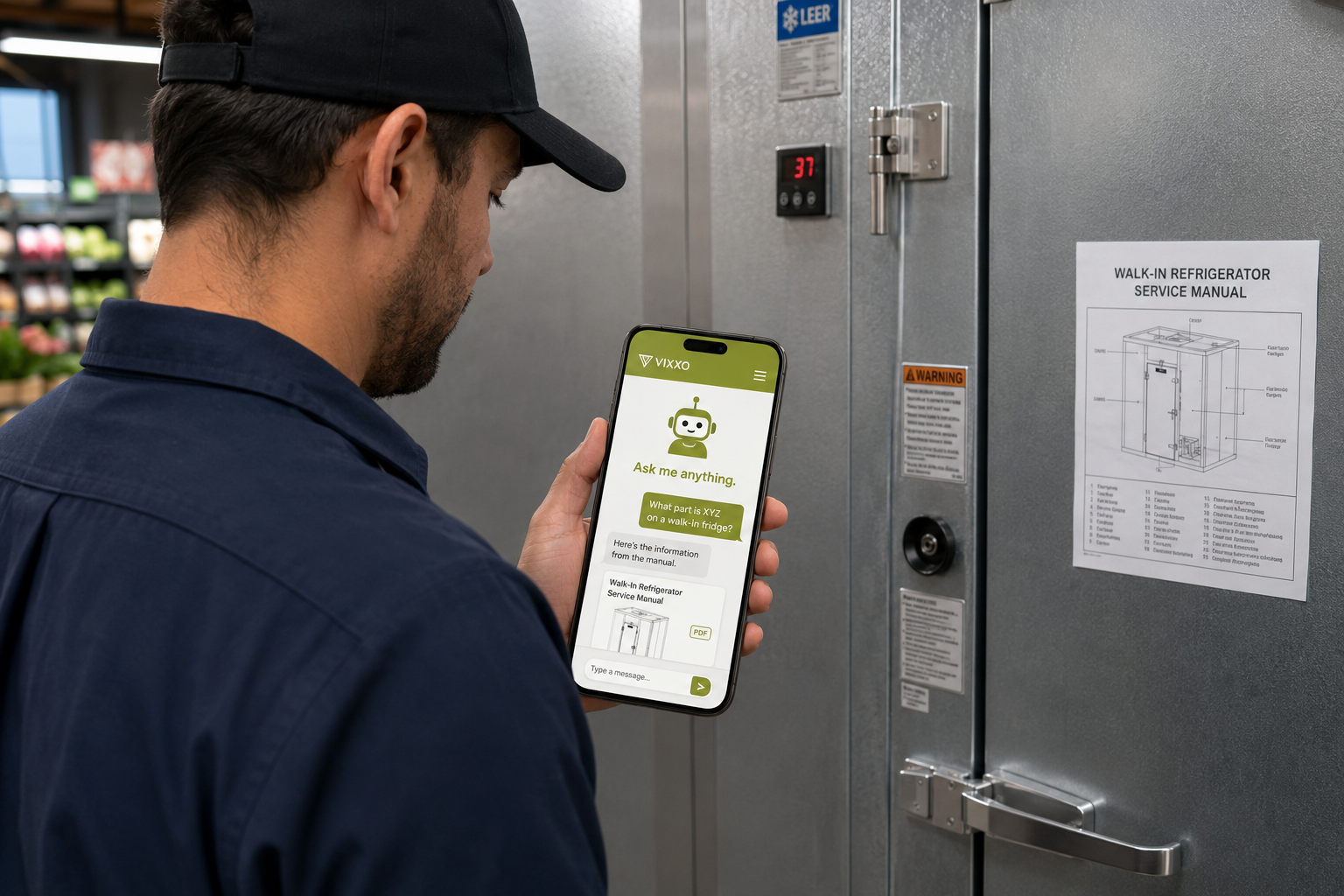
Vixxo’s AI assistant points to a practical use case: helping field technicians and support teams get to better answers faster when they are dealing with critical maintenance and repairs. In multi-site facilities, every minute spent hunting for equipment history, troubleshooting steps, or scope guidance can slow the outcome. AI helps close that gap.
Why the Knowledge Gap Matters
A technician may know the trade. A customer may know the location. Vixxo may know the asset, service history, common failure patterns, and customer expectations. The opportunity is bringing that context together at the moment it matters.
That is especially important for revenue-generating equipment and customer-facing repairs. A down coffee machine, failed refrigeration case, fuel equipment issue, or broken front-of-house asset is not just an operational problem. It can become a customer experience problem quickly.
The practical AI test:
Does it help the team get to the right next step faster while keeping accountability with the people responsible for the outcome?
What Changes When AI Supports the Field
AI helps by making institutional knowledge easier to use. Instead of forcing teams to search across old notes, manuals, prior work orders, and tribal knowledge, an assistant can help surface the right questions, likely causes, safety considerations, and next steps.
| Field moment | Common friction | How Vixxo’s AI assistant helps |
|---|---|---|
| Before diagnosis | Technician starts with limited issue history. | Surfaces relevant asset, symptom, and prior-work context faster. |
| During troubleshooting | Manuals, notes, and known issue patterns may be scattered. | Helps organize likely next questions and repair considerations. |
| Before escalation | Teams may not know what has already been checked. | Creates a clearer path for support teams to understand status and guide next steps. |
| After the visit | Learning from one site may not carry to the next. | Makes repeat patterns easier to recognize across locations and equipment types. |
The technician still owns the diagnosis. The service provider still performs the work. The human team still makes the call.
The difference is speed to useful context.
Why Multi-Site Operators Should Care
For facilities leaders, this matters because the industry is under pressure from every side. Equipment is more complex. Experienced labor is harder to find. Multi-site operators need consistent outcomes across very different markets.
A great technician in one region may know a pattern that another technician has not seen before. AI can help make that knowledge more portable.
| Service More consistent support for critical maintenance and repairs that shape customer experience. |
Speed Faster access to repair context when downtime is already affecting the site. |
Scale Shared knowledge can travel across locations, trades, and service provider teams. |
AI Should Strengthen Accountability, Not Remove It
The best AI use cases in facilities management do not remove accountability. They strengthen it. They help teams ask better questions earlier, reduce avoidable delay, and make clearer decisions before downtime turns into lost revenue or customer frustration.
That is the practical promise of AI in the field: not replacing expertise, but extending it.
When AI helps a technician understand the asset faster, review likely causes, and prepare for the next step, the work order moves with more confidence. When support teams can see patterns across locations, they can help resolve issues before they become chronic. When customers get clearer updates, they gain trust that the issue is being handled like it matters.
Critical equipment handled like it’s our own.
Vixxo owns the outcome on critical maintenance and repairs that matter most to customer experience. AI is one more way to help teams do that with more speed, consistency, and confidence.
Frequently Asked Questions
Does AI replace field technicians?
No. AI supports technicians with faster access to relevant information. People still diagnose, repair, verify, and make decisions.
Where does this help most?
It is most useful on critical equipment, repeat issues, complex assets, and customer-facing repairs where faster context can improve the outcome.
Why does this matter for multi-site operators?
Multi-site facilities teams need consistent decisions across many locations, trades, and service providers. AI can help make proven knowledge easier to reuse.
What should facilities leaders look for in AI?
Look for AI that improves speed and decision quality while preserving human accountability. The goal is better outcomes, not automation theater.
Topics: Facilities Management Artificial Intelligence
Thanksgiving Week Is the Stress Test for Grocery Facilities

Topics: Grocery Stores Facilities Management
Your CMMS Shows the Problem. AI Invoice Auditing Cuts the Bill

How AI invoice auditing closes the gap between facilities visibility and facilities cost control for multi-site operators.
Key takeaways
| ✓ | A CMMS tells you what work was ordered. It does not check whether the invoice for that work was fair. |
| ✓ | Lower hourly rates can hide longer labor durations, materials markups and repeat dispatches. |
| ✓ | Retail and convenience portfolios commonly overspend 10% to 15% because of limited oversight, duplicate work orders and inconsistent service quality. |
| ✓ | Automated, real-time invoice auditing catches overcharges before they reach the ledger. Vixxo reports 19% to 24% lower facilities overspend for operators using automated invoice auditing and outcome-based service contracts. |
The problem: you can see everything and still overspend
If you run hundreds or thousands of locations, you probably already have a computerized maintenance management system (CMMS). It logs work orders, tracks status and shows you which sites generate the most tickets. That is real visibility, and it is worth having.
But visibility is not control. A CMMS records that a technician was dispatched and that an invoice arrived. It does not, on its own, ask the harder questions:
|
?
|
Did the technician actually spend the hours billed? |
|
?
|
Is the parts price in line with the market in that region? |
|
?
|
Was this the second visit for the same fault? |
|
?
|
Is this a duplicate of a ticket opened last week? |
Without a structured process to answer those questions, the gap between what you can see and what you can control shows up as value leakage. Across a portfolio of thousands of locations, small overcharges accumulate into a seven-figure problem.
Where the money leaks
Four patterns account for most hidden spend in multi-site facilities programs.
| Leak | What it looks like | Why a CMMS alone misses it |
|---|---|---|
| Labor expansion | Hours billed exceed what the job normally takes | The system stores the invoice, not a benchmark for the job |
| Materials markups | Parts priced well above regional market rates | No pricing database sits behind the work order |
| Callbacks and repeat dispatches | The same issue is fixed more than once | Repeat calls are logged as separate tickets |
| Duplicate work orders | Two tickets for one problem | Duplicates look like normal volume |
A fifth pattern sits underneath all four: outlier sites. A handful of stores often drive a disproportionate share of spend, and without location-level analysis they stay hidden inside portfolio averages.
Why the lowest hourly rate is the wrong target
Many procurement teams negotiate on hourly labor rate because it is easy to compare. It is also an incomplete picture. A low rate can still add up to a larger bill through longer durations, materials markups and repeat visits.
Total cost of ownership is the more useful measure.
| 13.2% lower total invoice |
In one example Vixxo cites, a provider focused on total cost delivered a 13.2% lower total invoice despite charging a higher hourly rate. The rate looked worse on paper. The invoice told a different story. |
What AI invoice auditing does differently
AI invoice auditing moves the check from after the bill is paid to before it is approved. Instead of sampling invoices or reviewing them by hand, it evaluates every line item automatically. A strong audit system does four things:
|
1
|
Benchmarks against history It compares labor, parts and travel charges against decades of cost data and regional standards. |
|
2
|
Validates the work itself It checks geo-fenced time on site, local tax compliance and photo evidence that the job was completed. |
|
3
|
Flags anomalies in real time It catches labor rounding, parts markups, travel fees and duplicates while the work order is still in progress, not weeks later. |
|
4
|
Escalates to a human When a price deviates from the market-rate alternative, the invoice goes to a trade expert for detailed review. |
The last point matters. The goal is not to replace judgment. It is to point scarce expert attention at the invoices that need it, as a shared second set of eyes for everyone involved in the work.
How Vixxo approaches it
Vixxo built this model into VixxoLink, its facilities management platform, through two connected systems:
| VixxoVerify Patented invoice validation Reviews every invoice line item against more than 40 years of cost data and real-time benchmarks, and verifies job completion with photo evidence before the client receives a bill. |
CAPS Continuously Analyzed Pricing System Audits provider invoices in real time to address overages such as labor rounding, part markups and travel fees. It draws on more than 45 million industry- and region-specific data points. |
| 14% average excess materials cost found on invoices without oversight |
$2.6M direct cost savings for convenience and grocery clients in the 12 months ending August 31, 2026 |
What to look for in your own program
Whether you build, buy or partner, use this checklist to test whether your current setup controls cost or only reports it.
- Does every invoice line item get checked against a benchmark, or only a sample?
- Is the check done before approval or after payment?
- Can you see spend and repeat-call rates by individual location?
- Do you track provider performance, not just provider price?
- Can you verify time on site and job completion independently of the provider’s own records?
- Is there a human escalation path for flagged invoices?
If you answered no to more than two, your CMMS is giving you visibility without control.
Frequently asked questions
Does AI invoice auditing replace my CMMS?
No. The CMMS remains the system of record for work orders and assets. Auditing adds a cost-validation layer on top of it.
How much can a multi-site operator realistically save?
Vixxo publishes that operators using automated invoice auditing and outcome-based contracts reduce facilities overspend by 19% to 24%. Results depend on portfolio size, current oversight and provider mix.
What types of overcharges does automated auditing catch?
Labor rounding, extended durations, parts markups, travel fees, duplicate invoices and repeat dispatches for the same fault.
Is this only useful for very large portfolios?
Leakage compounds with scale, so the largest portfolios see the largest dollar impact. Any operator without location-level visibility into facilities spend can benefit.
Conclusion
Visibility is the starting point. Control comes from structured invoice audit, provider accountability and performance governance applied to every work order. For operators with nationwide locations, that combination is what turns a dashboard full of problems into a lower bill.
See how VixxoVerify puts a second set of eyes on every invoice.
Spend less. Stress less. One work order at a time.
Learn more about VixxoTopics: Facilities Management Artificial Intelligence
Why Door, Lock and Hardware Programs Break at Scale (and How to Fix Yours)

Topics: Facilities Management locks & hardware
Stores Are Holiday-Ready. Here’s How to Keep Them Running Through Black Friday

Topics: Retail Stores Facilities Management
Shorter Days Put the Fuel Forecourt in the Spotlight
Seasonal site readiness
A November exterior lighting walkthrough for convenience store and fuel site facilities teams.
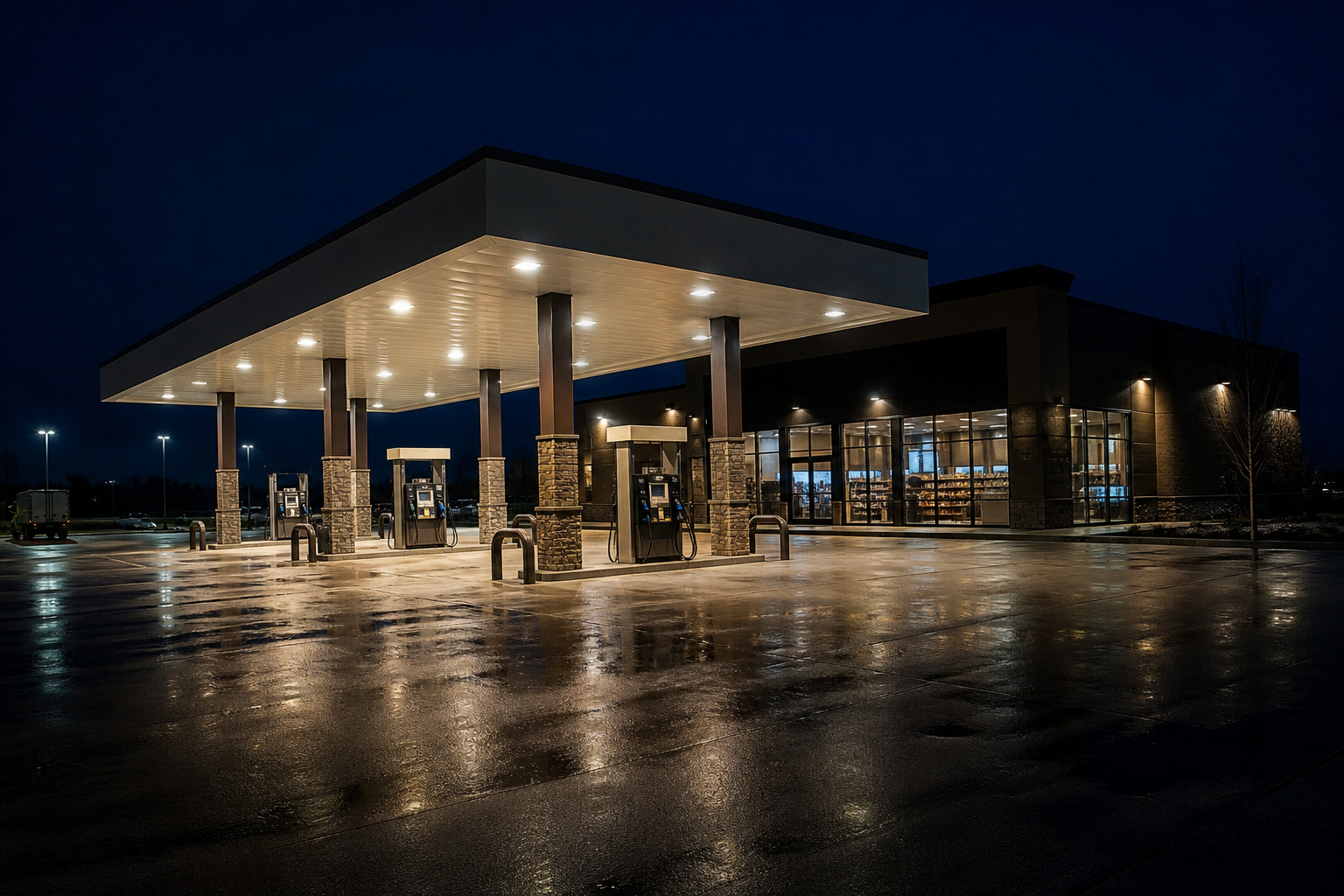
Every November, the clock change makes one facilities topic more visible almost overnight: exterior lighting. For convenience stores, shorter days do not just mean darker parking lots. They mean more fuel stops, foodservice visits, employee shift changes, and customer walk-ins happening under artificial light. The same site that looked ready at 3 p.m. can feel very different at 5:30 p.m., when a canopy fixture is dim, a timer is still on its summer schedule, or a shadow falls between the pump island and the front door.
That makes the clock change a practical reminder: inspect the site the way customers experience it after dark.
Why does exterior lighting matter more after the clocks change?
Convenience stores serve the dayparts that shorter daylight touches most: the morning commute, the evening commute, dinner-hour trips, and holiday travel. Customers are not only deciding whether a store is open. They are deciding whether the forecourt feels safe, easy to navigate, and worth stopping for.
Exterior lighting shapes that decision quickly. A bright, even forecourt helps customers see the pump, keypad, nozzle, receipt slot, nearby vehicles, walkways, entrances, and signage. It also supports employees who arrive, close, or change shifts during darker hours.
Lighting also carries brand trust. A well-lit canopy tells a driver the site is open and cared for before they ever reach the door, and that first impression is a core part of the customer experience.
What does the clock change bring to light?
Daylight saving time often highlights details that daytime visits cannot show. A fixture that dimmed over the summer may not stand out until sunset comes an hour earlier. A simple timer may still be set for summer hours. A photocell may be dirty or blocked. Tree growth, new signage, or site changes may have created shadows that were not obvious in daylight.
Commercial lighting and safety checklists consistently share one practice: walk the property after dark, not only during normal daytime inspections. A lot can look clean and well maintained at noon while still having dim pedestrian routes, uneven coverage, or glare that limits camera visibility after dusk. Different teams see different parts of a site, and an after-dark walk gives everyone a shared view of it.
Fuel sites deserve special attention at the canopy, which is part shelter, part lighting platform, and part brand system. A practical review looks for dark fixtures, cycling or flickering lights, uneven light between dispenser positions, lens damage, visible moisture, fascia lighting issues, and controls that turn lights on or off outside the expected schedule.
Electrical and canopy work belongs with qualified service providers. Site teams add the most value through safe observation and clear documentation, not by opening fixtures or troubleshooting energized equipment.
How do you run a November lighting readiness walkthrough?
The best inspection is a simple one: visit the site when the customer does. Walk it after dark, take photos, and document what needs attention before one dim fixture becomes a customer complaint or a safety concern.
| Stop | What to look at | What to capture |
|---|---|---|
| 1. The road view | Main sign, canopy fascia, building frontage, fuel price sign, entrance lighting | Does the site look open, safe, and easy to enter from the street? |
| 2. The customer path | Pump islands to the front door, restrooms, parking spaces, accessible routes, high-use sidewalks | Dark gaps, trip hazards, uneven transitions, glare, and places a customer might hesitate |
| 3. Canopy and pump islands | Fixtures that are out, dim, flickering, cycling, discolored, damaged, or showing moisture | The exact location, such as “north canopy, dispenser 4, two dark fixtures” |
| 4. Controls | Photocell, astronomical timer, simple timer, or building automation schedule | Whether the on and off times match the new sunset, especially for fixed timers |
| 5. Cameras and visibility | Camera views after dark | Glare, dark corners, blocked sightlines, dirty lenses, and bright pools next to deep shadows |
A closer look at lighting controls
A late schedule can leave a site under-lit during one of its busiest evening windows, so confirm how the lights turn on and what each control type needs after the clock change.
What belongs in a lighting work order?
Good documentation helps the service provider diagnose the issue faster and improves first-time fix potential. A strong lighting work order includes:
- Site number and exact location.
- Whether the issue involves the canopy, a pole light, a wall pack, a sign, the entrance, or a control schedule.
- Fixture location by pump number, pole number, building side, or photo markup.
- The symptom: out, flickering, dim, cycling, water intrusion, damaged lens, late timer, or photocell issue.
- Dusk or nighttime photos showing the area customers see.
- Whether the issue affects fueling, entrance visibility, employee areas, cameras, or accessible routes.
That level of detail turns a general lighting concern into actionable facilities work.
Frequently asked questions
When does daylight saving time end in 2026?
In most of the United States, clocks go back one hour at 2 a.m. on Sunday, November 1, 2026. Sunset then arrives an hour earlier on the clock.
Why does the clock change affect convenience store operations?
Evening commute, dinner-hour, and shift-change activity shifts into darkness. Fueling areas, entrances, walkways, and signage all depend on exterior lighting during those busy windows.
What should a site team check first?
Start with the customer view: the road, the path from the pumps to the door, the canopy, and the lighting controls. Take photos after dark and note exact fixture locations.
Who should repair canopy and exterior lighting issues?
Qualified electrical and canopy service providers. Site teams help most by observing safely and documenting clearly, without opening fixtures or working on energized equipment.
What makes a lighting work order faster to resolve?
Specific details: the exact location, the symptom, the area affected, and dusk or nighttime photos. A request like “north canopy, dispenser 4, two dark fixtures” gives a technician a head start.
The facilities opportunity
The clock change is a small seasonal event, but it creates a clear operational moment. It gives teams a reason to check exterior lighting before customers, employees, or store leaders ever need to mention it.
For convenience stores, the forecourt is the front door. When days get shorter, canopy and exterior lighting carry more of the customer experience, and keeping them ready supports safety, site appearance, fuel confidence, foodservice traffic, and brand trust.
The best move is simple: walk the site after dark, document what customers actually see, and route the right lighting work before the season turns every evening visit into a nighttime visit.
Vixxo helps multi-site operators keep critical exterior assets ready for the moments that matter most to customer experience, from fuel canopy lighting and parking lot fixtures to signage, controls, and seasonal site readiness. Learn more >>
Topics: Convenience Stores Signs & Lighting Facilities Management
Why Multi-Site Operators Are Rethinking Sign Quotes With AI